
Rabbi Eliyahu Meirav’s Amazing Shiur at the Home of Rabbi Eliezer Berland
Shlit”a
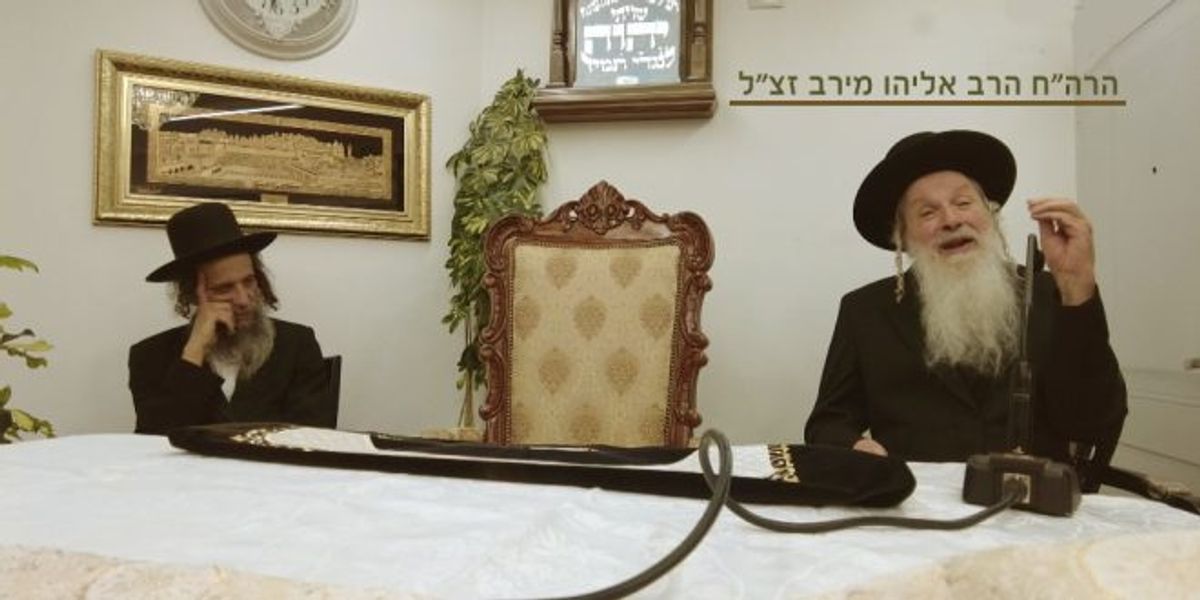
RABBI ELIYAHU MEIRAV ZT”L, IN AN AMAZING SHIUR WHICH HE GAVE ON ROSH CHODESH IYAR 5784, AT THE HOLY HOME OF MOREINU HARAV ELIEZER BERLAND SHLIT”A.
IN HIS HOLY WORDS, RABBI ELIYAHU MEIRAV ZT”L SPEAKS ABOUT HIS PROCESS OF DRAWING CLOSE TO CHASIDUT BRESLOV AND, IN PARTICULAR, TO HIS MASTER AND RABBI WHOM HE LOVED AND APPRECIATED, MOREINU HARAV BERLAND SHLIT”A. FROM HIS WORDS, WE CAN SEE JUST HOW MUCH HE IMMERSED HIMSELF IN THE PATHS OF HOLINESS AND FAITH WITH GREAT SELF-SACRIFICE ON THE ALL-IMPORTANT FOUNDATION OF EMUNAT CHACHAMIM (FAITH IN THE SAGES).
THESE ARE HIS HOLY WORDS:
There is an idea of people who are like you…
Where did we grow up? We grew up with communists [on a kibbutz].
Suddenly, I began to understand that there are people who appear like us, but they are something completely different.
Later on, when I started to learn Torah, I saw the Midrash Rabba which says that Moshe Rabbeinu is the man of God. The Midrash there says: What is a “man of God”? His upper half is Godly, his lower half is human. You begin to understand.
I merited to serve the Baba Sali a little bit, and I saw how he would read my thoughts and perform wondrous things. I literally had personal and individual education that truly emunat chachamim is the most difficult thing in the Torah. Really, we know this, that a person can believe in everything, and certainly in Tzaddikim who have already passed away, but to believe that in our generation, this dark generation with disputes, problems, hatred, wild permissiveness, and everything that is happening, to believe that there are still people who – I don’t know how to define them, such people who are truly connected to the Creator of the Universe.
https://vimeo.com/1033714122
Everyone believes in the Creator of the Universe, even, l’havdil, the gentiles, but there are people whom Hashem has granted to every generation. There is a well-known [comment] from the Ba’al HaTurim on Parashat Ki Tavo which explains: “Ki (when)” is the numerical value of 30, “Tavo (you come)” has the same letters of “Avot (Patriarchs),” “el ha’aretz (to the Land)” – this is how the parashah begins. The Ba’al HaTurim says that this comes to teach us that there is no generation that doesn’t have Tzaddikim in the Land of Israel who are like the holy Patriarchs – Avraham, Yitzchak, and Yaakov.
You haven’t found them? You are stuck wherever you are stuck? You think that “Everyone is deceptive and stupid like me”? Fine, you have a problem, but know that there is such a thing. Begin to search, begin to search!
I remember that the first time [I met the Rav], many years ago, a dear friend took me to a shiur which the Rav gave at Beit Pomerantz. For me, this was like the assembly at Mount Sinai, a new Sinai. Baruch Hashem, that we returned in repentance, and we merited to be by the Litvaks. My first rabbi was Rav Chaim Greineman a”h, a righteous and wonderful Jew. I was a kind of “Chazon Ish’nik,” inspired by the meticulousness in mitzvot and the diligence in Torah study. Thanks to Hashem Yitbarach, I merited to be a Litvak beforehand. Thanks to Hashem Yitbarach for the idea of “Torah, Torah, Torah, everything is bitul Torah [cancelling Torah story for nothing].” To this day, I remember that they once asked me to give a lecture. I had a good friend by the name of Adler, and I told him, “Should I leave my books? No way!”
He said to me, “No, this is very important. They’re opening yeshivas.” I told him, “I don’t know.” He said to me, “Should I ask one of the great sages of the generation?”
I asked him, “Who could you ask?”
He said to me, “I am close to Rabbi Chaim Shmuelevitz.” He was the mashgiach at the Mir Yeshiva – a very great man, as anyone who has read his books [knows].
“Very well, ask him. If he says for me to leave the books and to go, then fine, I’ll do it, because I need to hear from the Tzaddikim of the generation.”
Adler, my dear friend, was close to him. He said to him: “Listen, there is a certain Ba’al Teshuva [a returnee to Judaism], and he is such-and-such, and he told his story, and this brought people closer [to Judaism]. But he said that he doesn’t want to leave his books. All-in-all, he did teshuva [repentance] two and a half days ago. Suddenly, he turns into such a diligent learner. What is this? We need him and this is public outreach.”
Aryeh tells me that [the Rabbi] said, “Take him from his books?! There’s nothing in the world [that could] take him [from his books]!!” Aryeh came to me and said, “You were right. Forget it.”
This strength to learn and teach – therefore, the Rav always says, “Fortunate is the one who merited to be a Litvak beforehand.” Even though I say, “If only I had come straight from the Yom Kippur War to the Rav.” This was in 5734 (1974). Where he was, what was, I don’t know, but perhaps I wouldn’t have gone through what I went through, like what our holy Rebbe, Rabbi Avraham ben Rabbi Nachman, writes in Kokavei HaOr. He says, “If I had listened to my father and had known his greatness,” because he said to him, “Go to the Land of Israel, because you’re not for the exile.” [Rabbi Avraham] said, “If I had merited to listen to my father and to go straight to the Land of Israel, I wouldn’t have gone through what I went through in body and soul” – a person who suffered so terribly.
After the fact, we see that everything is exact and there’s no mistakes here. We just need to know and to ask for mercy regarding this. To know is to know that the Land of Israel, the World to Come, and the Torah are only acquired through suffering. There’s nothing to do about it. This is the formula, so much so that the greatest rabbis said, “Come, my brothers and colleagues – [referring to] the suffering.” Everyone knows the well-known Gemaras on Rabbi Elazar Bar Rabbi Shimon. Even Rabbeinu HaKadosh has this power. Suffering is the greatest gift, only that the Gemara says, “It’s not in our hands [to explain] the suffering of the Tzaddikim and the tranquility of the wicked” in this last generation.
But one thing I can tell you -- “From my flesh, I perceive God” – each person has gone through what he has gone through. The Rav always tells how once the Maggid of Mezritch sat with his student, the Baal HaTanya, and they learned the entire night. In the morning, he asked his holy and awesome student, “How many transgressions did you commit last night?” He didn’t ask him if he committed transgressions; he asked him, “How many transgressions did you commit last night?”
And he, with his phenomenal mind, thinks and says, “Two.” The Rav says that the Maggid said to him, “What, you only committed two? I committed 400 already.” Two angels from above such as these, who sit all night and learn Torah, and he says, “I committed 400.”
And he says, “I committed two.” What did they do that night? The Shechinah (Divine presence) was certainly there that night, and all the angels. They learned Torah, they learned Etz Chaim all night. They learned whatever they learned! In order to teach you that our reality is always as the Rav says: The very fact that we exist in a body, especially in this body. You are, Baruch Hashem, the second generation, the third generation. What can we say, what can we speak – fortunate are we that we merited to “good sons are a healing for their fathers,” as Rabbeinu says. So you, Baruch Hashem…
Years ago, someone came to me to cry. He says, “I saw some ‘Yediot Ahronot.’ What can I do? I saw some headline in ‘Yediot Ahronot.’” A child, who was then sixteen years old and in the yeshiva. These are [all] the transgressions, but your parents and grandparents – what Gehinnom (hell) they went through. At first glance, it looks like complete despair – who could rectify this? Especially someone who knows a little Zohar and understands what transgressions are. Only that Rabbeinu says a wondrous thing, in a lesson in Likutey Moharan – surely you’ve seen it: Transgression extinguishes mitzvot, but transgression does not extinguish Torah. Transgression doesn’t extinguish Torah.
Baruch Hashem, during all the years that I have merited to be a messenger of the Rav throughout the world – it has yet to be told about this what we saw and how we did it. Really, there [could be] complete books about what we merited to see, to see what this is. All the stories that you read in “Shivchei HaBaal Shem Tov,” “Shivchei HaAri z”l,” Shivchei Rabbeinu, we all saw with our own eyes, and much more than that, much more than that. I don’t know how we merited. Really, this is the only kushya (difficult question) that it’s possible to ask – how did I merit this?
I don’t know how I merited it, I don’t know how my sons merited it, I don’t know how you merited it. This is a kushya that it’s still permissible to ask, but we merited; in actuality, we merited. It’s clear to me that if we hadn’t been close followers, let’s say “close followers” in double and triple quotations marks, but let’s say it with simplicity -- belonging to this holy community. To boast that we are close followers? Bezrat Hashem, maybe yes. I hope. We are praying for this, longing for this, acting for this. It’s clear to me that I wouldn’t have survived the past few years, what we went through spiritually, physically. I would not have survived. But every time we come here, every time that we see this holy face, every time we hear words, especially the new books which have come out.
The new book, “HaNechmadim MiZahav U’Faz Rav” never leaves my table. Every word is truly refined, every word gives life, every word shines, and every word cries out: “You are not alone. Hashem is with you. Don’t get confused by anything. We go through what we go through. This is nothing compared to what still awaits you. There will be more good, more wonders, we will yet merit. These hardships are very, very great gifts.” And I know this myself. I experienced it firsthand, many times, that the Rav would call me on all types of occasions. Baruch Hashem, we merited. Also today, we merit in all types of impossible situations. Suddenly, we find some ray of light that we didn’t think of, mamash, like the splitting of the Red Sea in every place, and Hashem helps.
I’ll finish with one teaching from the Sfat Emet. This is a teaching that really illuminates that we heard from the Rav years ago. The verse says in Devarim (8:5), “As a man will discipline his son, so Hashem your God disciplines you.” And he asks there why the language of “will discipline” in the future tense. It should have been written “disciplines” in the present tense. “I am your Father. A father disciplines his son, and I discipline you like a father disciplines his son.” The Sfat Emet says that this is the simple meaning of the verse.
The Rav said a wonderful teaching, in the name of the Sfat Emet of course. Know, that the Kadosh Baruch Hu says: I discipline you like a man will discipline his son. That is to say, that a father such as this has yet to be born, who will one day discipline [in the future tense], who will be the perfect father who knows how he will discipline his son – in this way, I will discipline you. The hardships that I discipline you with are “as [a father] will discipline.” There is no father like this in existence, but perhaps one day such a wondrous father will be born who will know how he will discipline his children, in the most correct way, the most precise way, so as to not make them fall, so as to not break them, so as to give them life, so that they will remain after the hardships infused with faith, trust, joy, after everything they went through.
And this is the point, “As a man will discipline his son” – Rabbeinu HaKadosh, Moreinu HaRav HaKadosh disciplines us. We can’t say that we aren’t going through suffering, this wasn’t said, but the sweetening compared to what was fitting to be… How Rabbeinu says it, “Love your fellow as yourself” – do not say “your fellow (re’ach),” but as “your adversary (ra’acha),” because “…like yourself…I am Hashem.” As was fitting to be, the required rectifications, each person knows himself what he has transgressed, and how he has transgressed, what he needs. It used to be that a person would need to be reincarnated a millions times to reach his rectification, but [now] we reach Rabbeinu HaKadosh and finish everything.
Why am I saying this? Because every single instruction, every single request [of the Rav has meaning]. Again I want to say that at the beginning of my drawing close many years ago, the Rav said this to me. The Rav himself told me, and this greatly helped me throughout my life. I repeat this many times, because this is the fundamental of drawing close. He said to me, “Know that I hate robots! Even if I say for you to do something, contemplate it! If I say to you, for example, to jump from the roof, then don’t jump from the roof of …. Tower. I don’t know, find a low roof! Do what I tell you, but do it with intelligence. Don’t be a robot!”
Because the words of the Tzaddikim are deeper than the sea, and over the years, I’ve encountered things which the Rav said to people, and they didn’t grasp them. He leads a person, and in the end, if someone holds onto simplicity, in the end, he reaches the most wondrous things. Just that sometimes, people fall along the way. Some of my best friends fell along the way. Everything that happened in Shuvu Banim in recent years, my best friends, truly dear friends, good friends, but they didn’t hold on. This isn’t simple. It’s fire.
Rabbeinu says in Lesson 31 that drawing close to the Tzaddik is entering the Pardes [lit. orchard; e.g. mystical ascent, as brought in the story of the four sages who ascended to the orchard]. One died, one went insane, one became a heretic, and one entered in peace. When I saw Lesson 31 years ago, Baruch Hashem, under the Rav’s guidance, I went to do six hours of Hitbodedut. Immediately, screams: How can I draw close now? But I’m a Litvak, it’s good for me there. I learn Torah, everything is good and fine. I’m a kollel student, and now should I enter a place where it’s possible to die, where it’s possible to go insane and to become a heretic? What, am I crazy?
Go pray that you merit, in the merit of Rabbi Akiva, to enter in peace and exit in peace. Perhaps in the merit of this prayer, we merited to remain here, and we will merit to remain here. Understandably, everything is in the merit of the Rav, Bezrat Hashem, up to and including 120, now and in the future. That’s our entire hope.
Bezrat Hashem, I believe with complete faith that certainly, how the Rav says it… every day, he says that today is such-and-such, and every day is the loftiest day of the year; every day, the redemption is supposed to happen. Because this is really true. What can we do that we don’t merit it, but the Tzaddik sees. Now, with a small amount of arousal from below, it’s possible to reach what is possible to reach, with simplicity and sincerity.
Really, to merit to learn, pray, to be kosher Jews, to guard one’s eyes, to preserve holiness, and to do everything properly through the power of the true Tzaddik – and to not take credit for oneself; this is one of the conditions for entering the World to Come.
“One who bends down and enters, bends down and exits” “and always studies Torah,” but the main thing is “and does not take credit for oneself” (Sanhedrin 88b) – because this is the greatest accuser. Know that everything is through the power of the Tzaddik, and don’t take any credit for yourself. Even if these are the most wondrous things, know that everything is through the power of the Tzaddik who influences us and gives to us.
May it be His will that we should merit this.
Subscribe to Our Newsletter
Receive Torah articles and inspiration directly in your inbox