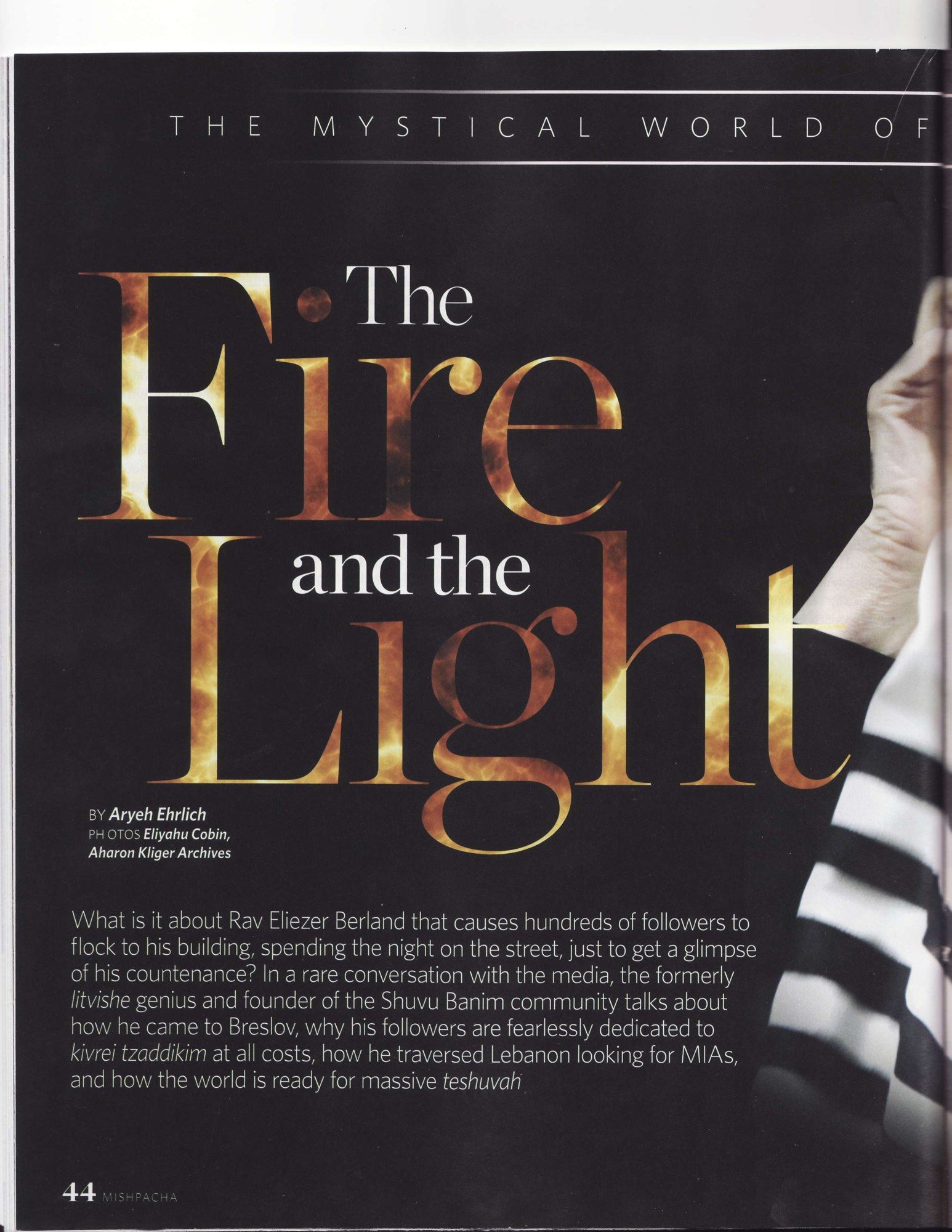
The Fire and the Light: The Mystical World of Rav Eliezer Berland shlit"a
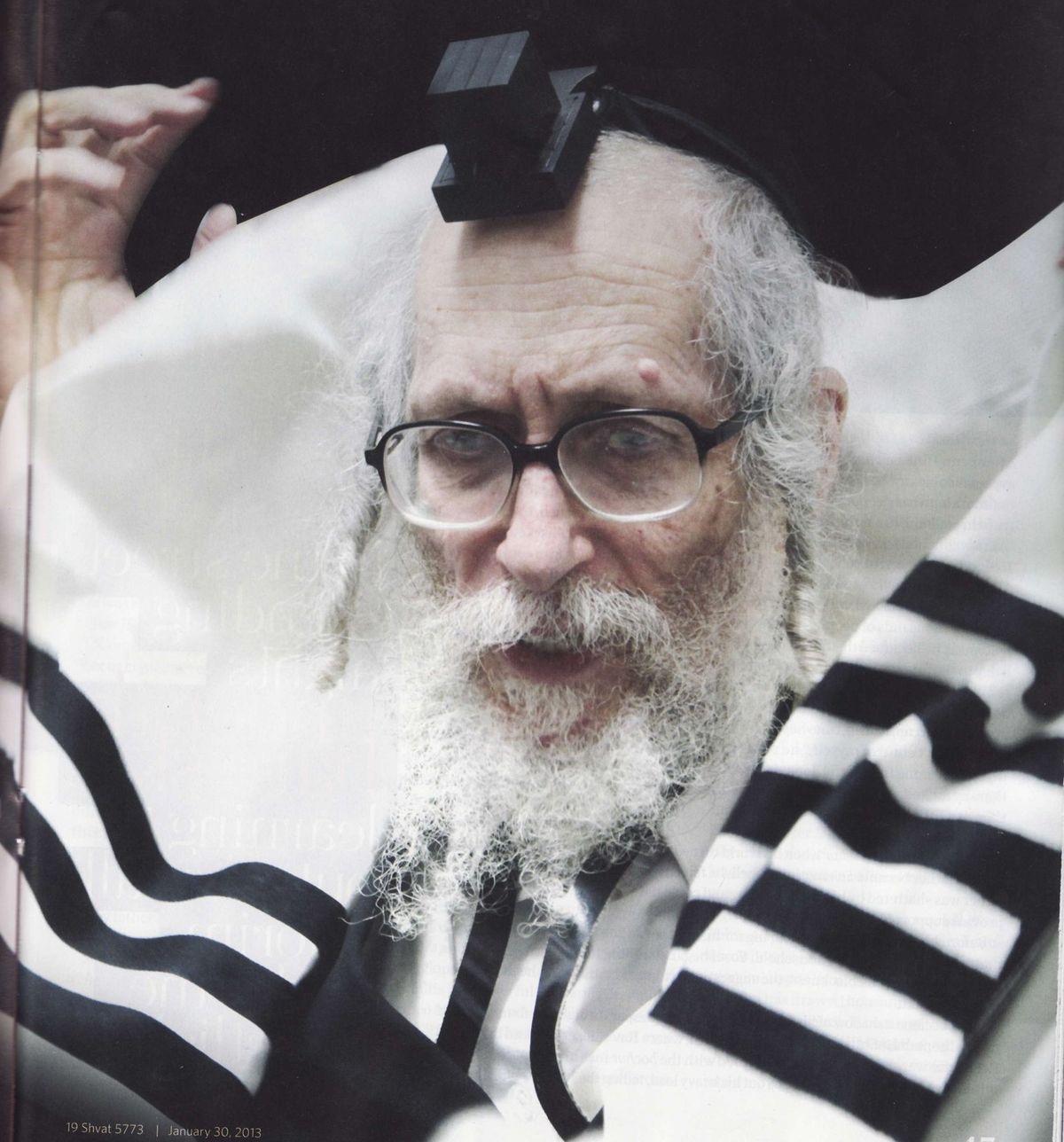
What is it about Rav Eliezer Berland that causes hundreds of followers to flock to his building, spending the night on the street, just to get a glimpse of his countenance? In a rare conversation with the media, the formerly litvishe genius and founder of the Shuvu Banim community talks about how he came to Breslov, why his followers are fearlessly dedicated to kivrei tzaddikim at all costs, how he traversed Lebanon looking for MIAs, and how the world is ready for massive teshuvah.
By Aryeh Ehrlich · Photos: Eliyahu Cobin, Aharon Kliger Archives · Mishpacha Magazine, 19 Shvat 5773 / January 30, 2013
After Benny finished his training course, he had good intentions when he took a job in a secular company; he was sure he'd be able to influence his colleagues positively while maintaining a barrier between himself and the open world around him. But as Benny rose through the ranks, his strong connection to yiddishkeit weakened.
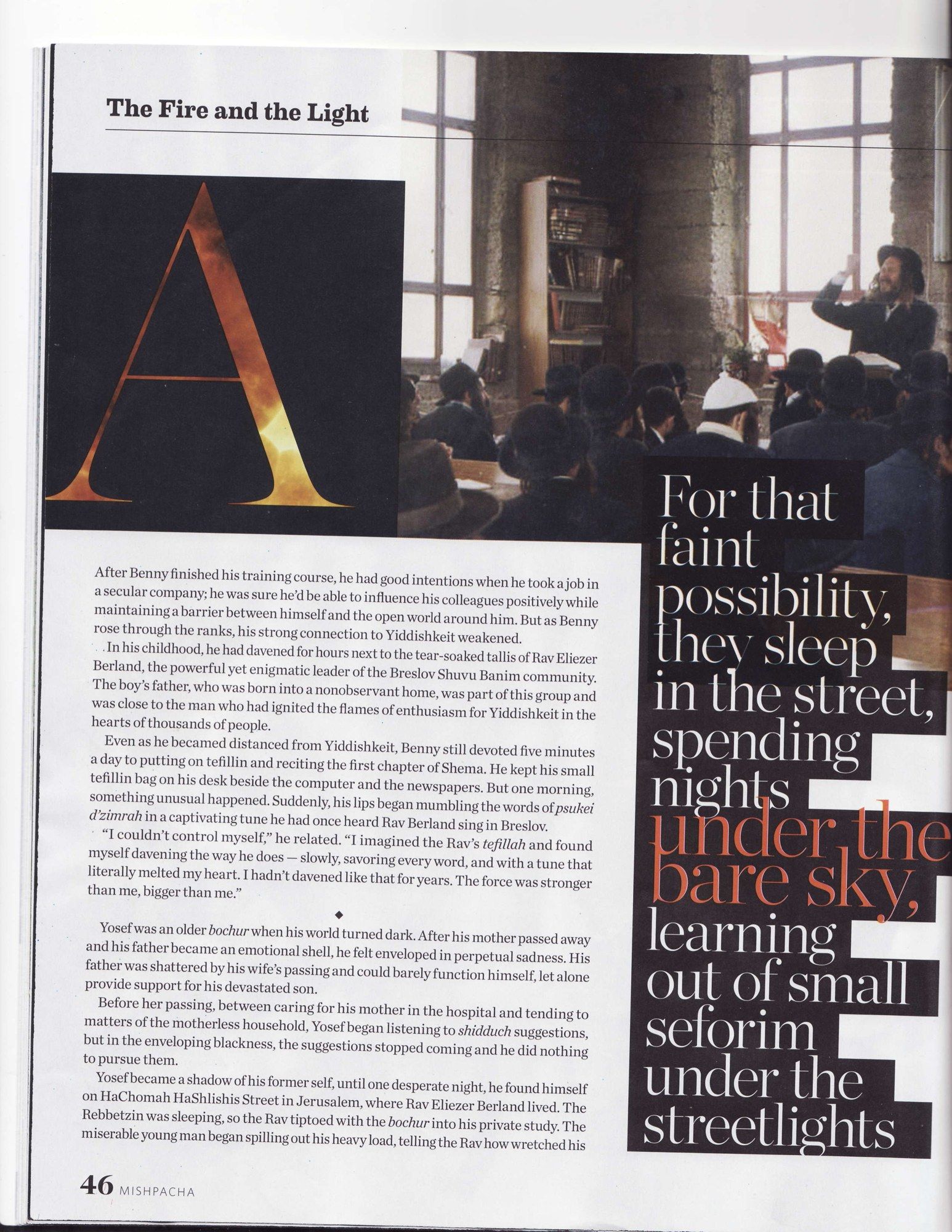
In his childhood, he had davened for hours next to the tear-soaked tallis of Rav Eliezer Berland, the powerful yet enigmatic leader of the Breslov Shuvu Banim community. The boy's father, who was born into a nonobservant home, was part of this group and was close to the man who had ignited the flames of enthusiasm for yiddishkeit in the hearts of thousands of people.
Even as he became distanced from yiddishkeit, Benny still devoted five minutes a day to putting on tefillin and reciting the first chapter of Shema. He kept his small tefillin bag on his desk beside the computer and the newspapers. But one morning, something unusual happened. Suddenly, his lips began mumbling the words of pesukei d'zimrah in a captivating tune he had once heard Rav Berland sing in Breslov.
"I couldn't control myself," he related. "I imagined the Rav's tefillah and found myself davening the way he does — slowly, savoring every word, and with a tune that literally melted my heart. I hadn't davened like that for years. The force was stronger than me, bigger than me."
For that faint possibility, they sleep in the street, spending nights under the bare sky, learning out of small seforim under the streetlights
Yosef was an older bochur when his world turned dark. After his mother passed away and his father became an emotional shell, he felt enveloped in perpetual sadness. His father was shattered by his wife's passing and could barely function himself, let alone provide support for his devastated son.
Before her passing, between caring for his mother in the hospital and tending to matters of the motherless household, Yosef began listening to shidduch suggestions, but in the enveloping blackness, the suggestions stopped coming and he did nothing to pursue them.
Yosef became a shadow of his former self, until one desperate night, he found himself on Hachomah Hashlishis street in Jerusalem, where Rav Eliezer Berland lived. The Rebbetzin was sleeping, so the Rav tiptoed with the bochur into his private study. The miserable young man began spilling out his heavy load, telling the Rav how wretched his life was and how he wished he were dead.
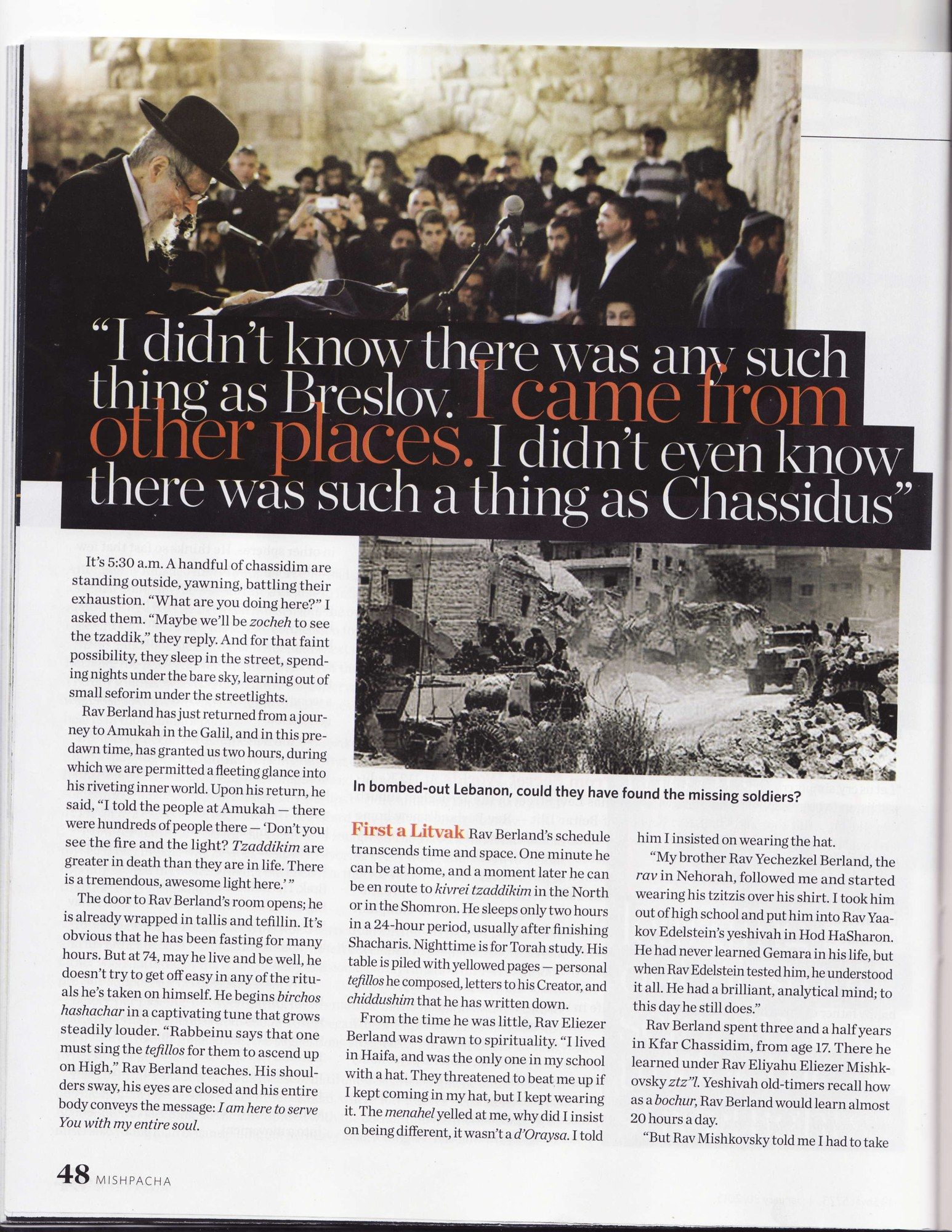
Rav Elya Lopian with his inner circle. "Chassidus is really for Litvaks"
Rav Berland was silent.
"Come, let us cry together," he said finally. "Let us cry, simply cry. HaKadosh Baruch Hu will listen to our weeping." And that's what they did. For a full hour and a half Rav Berland held the hand of a young man he didn't know, and they wept together.
Rav Berland then asked Yosef to wait. He went down to the mikveh, and returned a few minutes later, bursting back into the room, this time encouraging and full of smiles. "Forget everything. From now on, Hashem will treat you with great kindness."
I heard this from Yosef himself, today a happy father of three little children.
Several years ago on Chol HaMoed Pesach, a chassidishe bochur davening at the Kosel suddenly felt a crush and commotion behind him. Rav Berland was conducting a ceremony l'zecher aliyah l'regel, with a large crowd of his talmidim. The crowd was pushing and shoving to get as close as they could to the Rav, when suddenly, his eyes fixed on the bochur he'd never met.
"By the week of Shavuos, you will be engaged," Rav Berland stated. The bochur heard, but was surprised; he hadn't asked for a brachah — and he wasn't even interested in getting married yet.
All plans aside, on the day after Shavuos, the bochur became engaged. That bochur was me.
From Secret Worlds
At 112 Kedushas Levi Street in the Jerusalem suburb of Beitar Illit — Rav Berland's new home — masses flock from all over the country just to stand outside the building. Most of them will not even get to see his face, but will suffice with being in close proximity. When neighbors began to complain about harassment, Rav Berland issued a warning that no one should dare disturb the other residents.
Rav Eliezer Berland is a mystery, and his life in recent years has been fraught with rumors and intrigue surrounding the power struggle over his institutions. Yet wrapped in his tallis is a powerful, esoteric personality hidden from those who seek him, the secrets of his life too elusive to be deciphered even by those who are closest to him.
When he speaks, his thoughts seem to roam in other spheres. He thinks so fast that few can keep up with him.
Concepts from the secret world of sod pepper his conversations — even when discussing day-to-day matters. When he speaks, his entire body moves with his lips as his eyes seem to rise to the Heavens. In Breslov they call this nishmas peleh, chiddush b'doro, a wondrous soul that is an innovation in his generation.
He was born in Haifa in 1937 into a national religious family, spending his youth in Bnei Akiva in the early years of the state. He later slaked his thirst for Torah in the Lithuanian Torah world, as he spent entire days bent over his seforim in Yeshivas Knesses Chizkiyahu in Kfar Chassidim, and later in Kollel Ponevezh and Kollel Volozhin in Bnei Brak. His influences were Rosh Yeshivah Rav Eliyahu Eliezer Mishkovsky, Mashgiach Rav Eliyahu Lopian, the Steipler Gaon, and other leading Torah giants in Bnei Brak of the last generation.
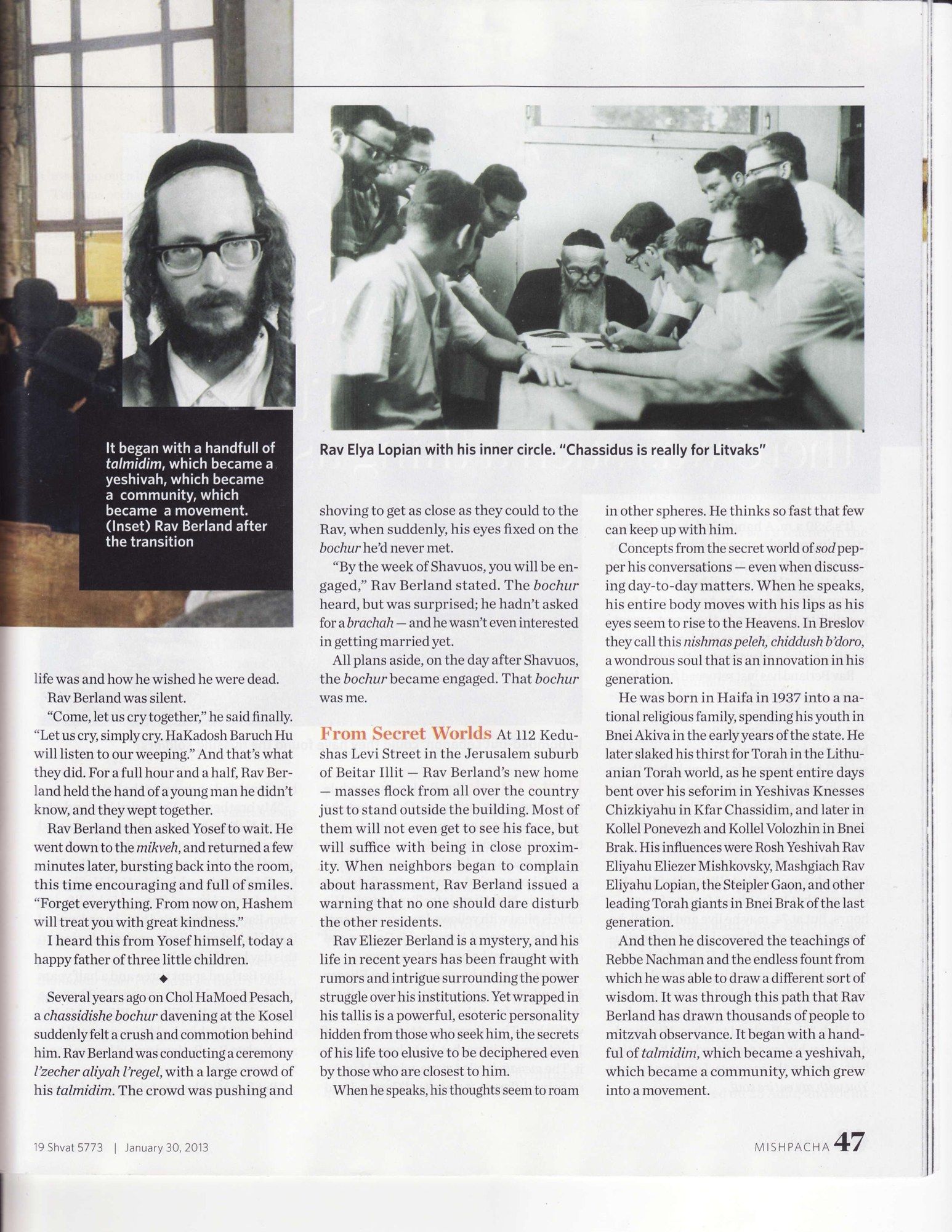
And then he discovered the teachings of Rebbe Nachman and the endless fount from which he was able to draw a different sort of wisdom. It was through this path that Rav Berland has drawn thousands of people to mitzvah observance. It began with a handful of talmidim, which became a yeshivah, which became a community, which grew into a movement.
It's 5:30 a.m. A handful of chassidim are standing outside, yawning, battling their exhaustion. "What are you doing here?" I asked them. "Maybe we'll be zocheh to see the tzaddik," they reply. And for that faint possibility, they sleep in the street, spending nights under the bare sky, learning out of small seforim under the streetlights.
Rav Berland has just returned from a journey to Amukah in the Galil, and in this pre-dawn time, has granted us two hours, during which we are permitted a fleeting glance into his riveting inner world. Upon his return, he said, "I told the people at Amukah — there were hundreds of people there — 'Don't you see the fire and the light? Tzaddikim are greater in death than they are in life. There is a tremendous, awesome light here.'"
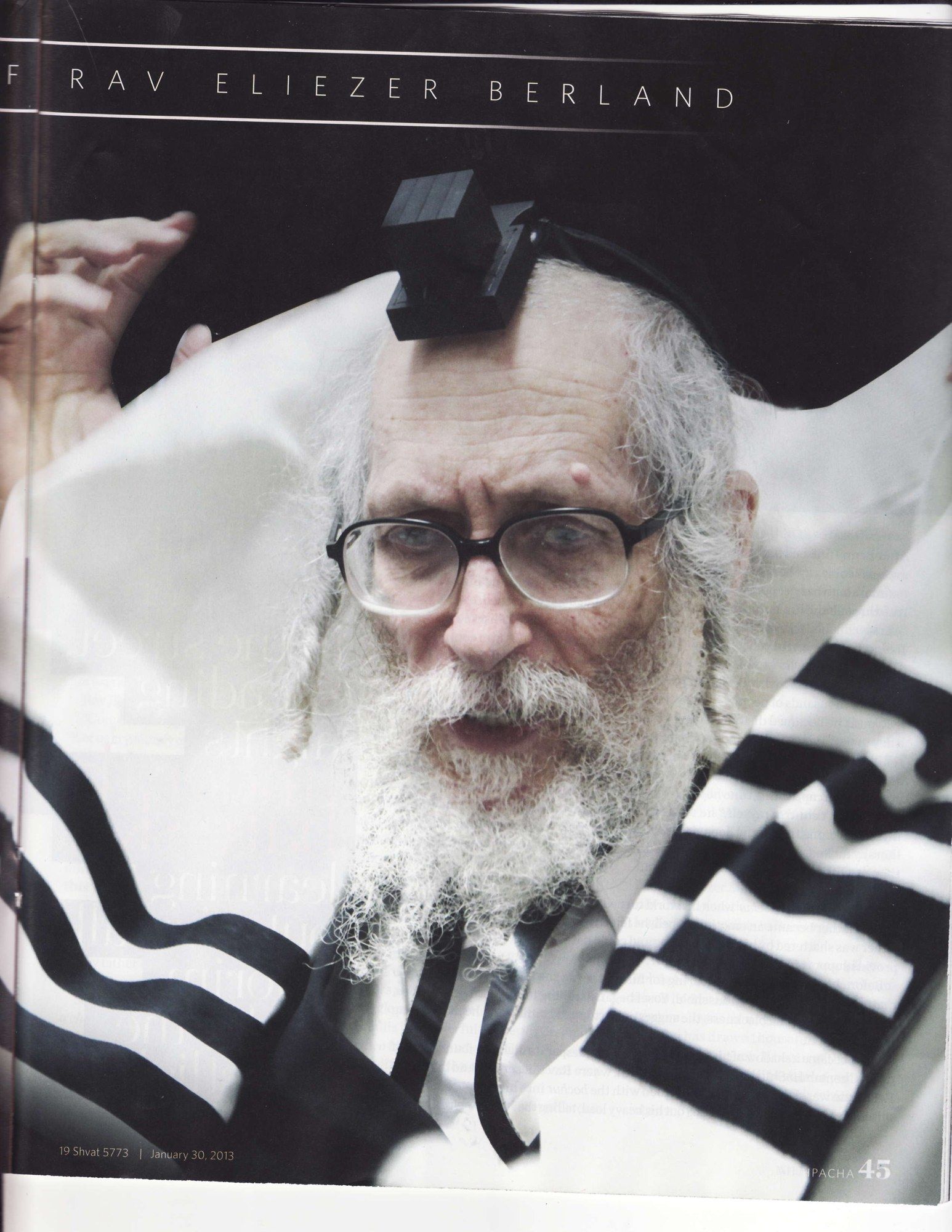
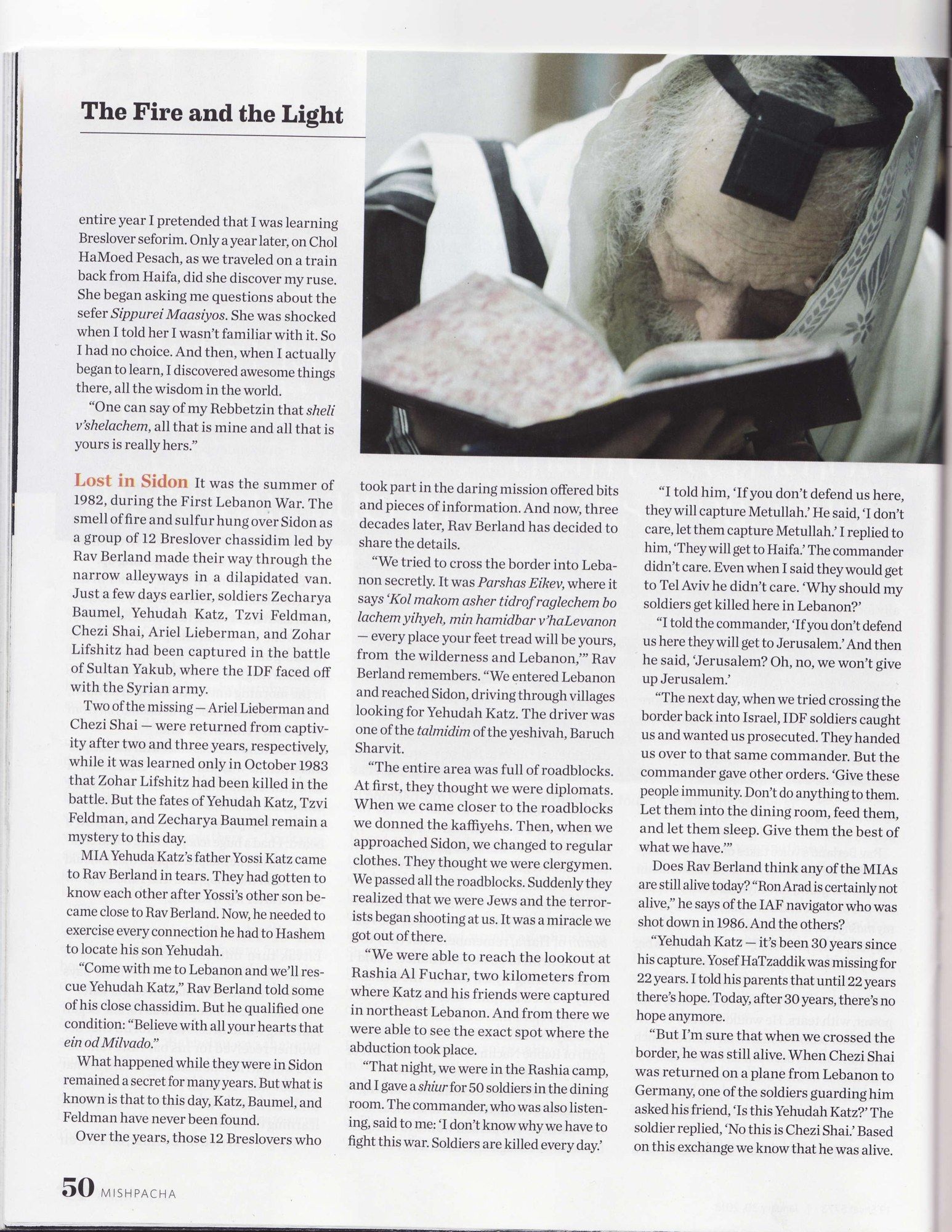
The door to Rav Berland's room opens: he is already wrapped in tallis and tefillin. It's obvious that he has been fasting for many hours. But at 74, may he live and be well, he doesn't try to get off easy in any of the rituals he's taken on himself. He begins birchos hashachar in a captivating tune that grows steadily louder. "Rabbeinu says that one must sing the tefillos for them to ascend up on High," Rav Berland teaches. His shoulders sway, his eyes are closed and his entire body conveys the message: I am here to serve You with my entire soul.
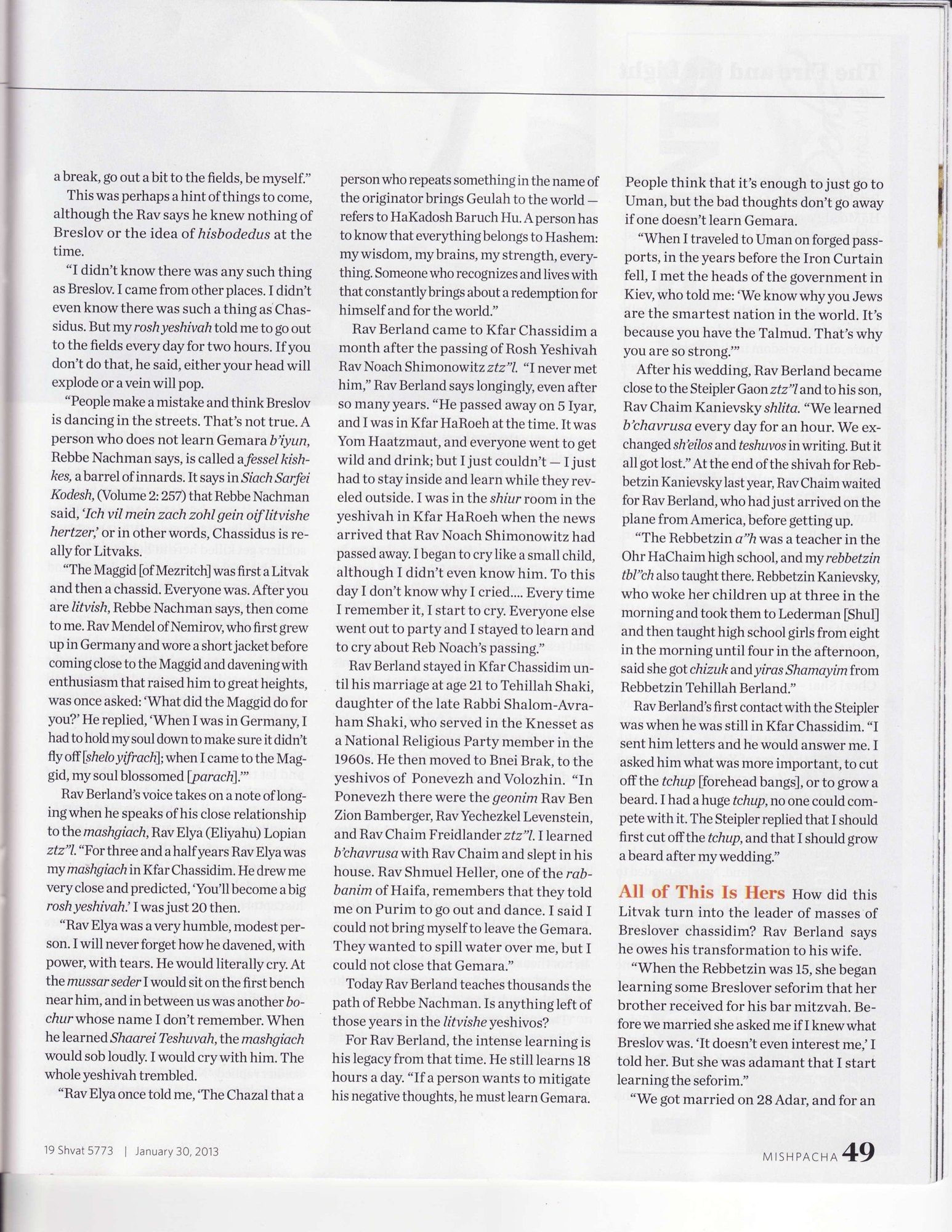
In bombed-out Lebanon, could they have found the missing soldiers?
“I didn’t know there was any such thing as Breslov. I came from other places. I didn’t even know there was such a thing as Chassidus”
First a Litvak
Rav Berland's schedule transcends time and space. One minute he can be at home, and a moment later he can be en route to kivrei tzaddikim in the North or in the Shomron. He sleeps only two hours in a 24-hour period, usually after finishing Shacharis. Nighttime is for Torah study. His table is piled with yellowed pages — personal tefillos he composed, letters to his Creator, and chiddushim that he has written down.
From the time he was little, Rav Eliezer Berland was drawn to spirituality. "I lived in Haifa, and was the only one in my school with a hat. They threatened to beat me up if I kept coming in my hat, but I kept wearing it. The menahel yelled at me, why did I insist on being different, it wasn't a d'Oraysa. I told him I insisted on wearing the hat.
"My brother Rav Yechezkel Berland, the rav in Nehorah, followed me and started wearing his tzitzis over his shirt. I took him out of high school and put him into Rav Yaakov Edelstein's yeshivah in Hod HaSharon. He had never learned Gemara in his life, but when Rav Edelstein tested him, he understood it all. He had a brilliant, analytical mind; to this day he still does."
Rav Berland spent three and a half years in Kfar Chassidim, from age 17. There he learned under Rav Eliyahu Eliezer Mishkovsky ztz"l. Yeshivah old-timers recall how as a bochur, Rav Berland would learn almost 20 hours a day.
"But Rav Mishkovsky told me I had to take a break, go out a bit to the fields, be myself." This was perhaps a hint of things to come, although the Rav says he knew nothing of Breslov or the idea of hisbodedus at the time.
"I didn't know there was any such thing as Breslov. I came from other places. I didn't even know there was such a thing as Chassidus. But my rosh yeshivah told me to go out to the fields every day for two hours. If you don't do that, he said, either your head will explode or a vein will pop.
"People make a mistake and think Breslov is dancing in the streets. That's not true. A person who does not learn Gemara b'iyun, Rebbe Nachman says, is called a fessel kishkes, a barrel of innards. It says in Siach Sarfei Kodesh, (Volume 2:257) that Rebbe Nachman said, 'Ich vil mein zach zohl gein oif litvishe hertzer,' or in other words, Chassidus is really for Litvaks.
"The Maggid [of Mezritch] was first a Litvak and then a chassid. Everyone was. After you are litvish, Rebbe Nachman says, then come to me. Rav Mendel of Nemirov, who first grew up in Germany and wore a short jacket before coming close to the Maggid and davening with enthusiasm that raised him to great heights, was once asked: 'What did the Maggid do for you?' He replied, 'When I was in Germany, I had to hold my soul down to make sure it didn't fly off [shelo yifrach]; when I came to the Maggid, my soul blossomed [parach].'"
Rav Berland's voice takes on a note of longing when he speaks of his close relationship to the mashgiach, Rav Elya (Eliyahu) Lopian ztz"l. "For three and a half years Rav Elya was my mashgiach in Kfar Chassidim. He drew me very close and predicted, 'You'll become a big rosh yeshivah.' I was just 20 then.
"Rav Elya was a very humble, modest person. I will never forget how he davened, with power, with tears. He would literally cry. At the mussar seder I would sit on the first bench near him, and in between us was another bochur whose name I don't remember. When he learned Shaarei Teshuvah, the mashgiach would sob loudly. I would cry with him. The whole yeshivah trembled.
"Rav Elya once told me, 'The Chazal that a person who repeats something in the name of the originator brings Geulah to the world — refers to HaKadosh Baruch Hu. A person has to know that everything belongs to Hashem: my wisdom, my brains, my strength, everything. Someone who recognizes and lives with that constantly brings about a redemption for himself and for the world."
Rav Berland came to Kfar Chassidim a month after the passing of Rosh Yeshivah Rav Noach Shimonowitz ztz"l. "I never met him," Rav Berland says longingly, even after so many years. "He passed away on 5 Iyar, and I was in Kfar HaRoeh at the time. It was Yom Haatzmaut, and everyone went to get wild and drink; but I just couldn't — I just had to stay inside and learn while they reveled outside. I was in the shiur room in the yeshivah in Kfar HaRoeh when the news arrived that Rav Noach Shimonowitz had passed away. I began to cry like a small child, although I didn't even know him. To this day I don't know why I cried.... Every time I remember it, I start to cry. Everyone else went out to party and I stayed to learn and to cry about Reb Noach's passing."
Rav Berland stayed in Kfar Chassidim until his marriage at age 21 to Tehillah Shaki, daughter of the late Rabbi Shalom-Avraham Shaki, who served in the Knesset as a National Religious Party member in the 1960s. He then moved to Bnei Brak, to the yeshivos of Ponevezh and Volozhin. "In Ponevezh there were the geonim Rav Ben Zion Bamberger, Rav Yechezkel Levenstein, and Rav Chaim Freidlander ztz"l. I learned b'chavrusa with Rav Chaim and slept in his house. Rav Shmuel Heller, one of the rabbanim of Haifa, remembers that they told me on Purim to go out and dance. I said I could not bring myself to leave the Gemara. They wanted to spill water over me, but I could not close that Gemara."
Today Rav Berland teaches thousands the path of Rebbe Nachman. Is anything left of those years in the litvishe yeshivos?
For Rav Berland, the intense learning is his legacy from that time. He still learns 18 hours a day. "If a person wants to mitigate his negative thoughts, he must learn Gemara. People think that it's enough to just go to Uman, but the bad thoughts don't go away if one doesn't learn Gemara.
"When I traveled to Uman on forged passports, in the years before the Iron Curtain fell, I met the heads of the government in Kiev, who told me: 'We know why you Jews are the smartest nation in the world. It's because you have the Talmud. That's why you are so strong.'"
After his wedding, Rav Berland became close to the Steipler Gaon ztz"l and to his son, Rav Chaim Kanievsky shlita. "We learned b'chavrusa every day for an hour. We exchanged she'eilos and teshuvos in writing. But it all got lost." At the end of the shivah for Rebbetzin Kanievsky last year, Rav Chaim waited for Rav Berland, who had just arrived on the plane from America, before getting up.
"The Rebbetzin a"h was a teacher in the Ohr HaChaim high school, and my rebbetzin tbl’ch also taught there. Rebbetzin Kanievsky, who woke her children up at three in the morning and took them to Lederman [Shul] and then taught high school girls from eight in the morning until four in the afternoon, said she got chizuk and yiras Shamayim from Rebbetzin Tehillah Berland."
Rav Berland's first contact with the Steipler was when he was still in Kfar Chassidim. "I sent him letters and he would answer me. I asked him what was more important, to cut off the tchup [forehead bangs], or to grow a beard. I had a huge tchup, no one could compete with it. The Steipler replied that I should first cut off the tchup, and that I should grow a beard after my wedding."
All of This Is Hers
How did this Litvak turn into the leader of masses of Breslover chassidim? Rav Berland says he owes his transformation to his wife. "When the Rebbetzin was 15, she began learning some Breslover seforim that her brother received for his bar mitzvah. Before we married she asked me if I knew what Breslov was. 'It doesn't even interest me,' I told her. But she was adamant that I start learning the seforim."
"We got married on 28 Adar, and for an entire year I pretended that I was learning Breslover seforim. Only a year later, on Chol HaMoed Pesach, as we traveled on a train back from Haifa, did she discover my ruse. She began asking me questions about the sefer Sippurei Maasiyos. She was shocked when I told her I wasn't familiar with it. So I had no choice. And then, when I actually began to learn, I discovered awesome things there, all the wisdom in the world.
"One can say of my Rebbetzin that sheli v'shelachem, all that is mine and all that is yours is really hers."
Lost in Sidon
It was the summer of 1982, during the First Lebanon War. The smell of fire and sulfur hung over Sidon as a group of 12 Breslover chassidim led by Rav Berland made their way through the narrow alleyways in a dilapidated van.
Just a few days earlier, soldiers Zecharya Baumel, Yehudah Katz, Tzvi Feldman, Chezi Shai, Ariel Lieberman, and Zohar Lifshitz had been captured in the battle of Sultan Yakub, where the IDF faced off with the Syrian army.
Two of the missing — Ariel Lieberman and Chezi Shai — were returned from captivity after two and three years, respectively, while it was learned only in October 1985 that Zohar Lifshitz had been killed in the battle. But the fates of Yehudah Katz, Tzvi Feldman, and Zecharya Baumel remain a mystery to this day.
MIA Yehuda Katz's father Yossi Katz came to Rav Berland in tears. They had gotten to know each other after Yossi's other son became close to Rav Berland. Now, he needed to exercise every connection he had to Hashem to locate his son Yehudah.
"Come with me to Lebanon and we'll rescue Yehudah Katz," Rav Berland told some of his close chassidim. But he qualified one condition: "Believe with all your hearts that ein od Milvado."
What happened while they were in Sidon remained a secret for many years. But what is known is that to this day, Katz, Baumel, and Feldman have never been found.
Over the years, those 12 Breslovers who took part in the daring mission offered bits and pieces of information. And now, three decades later, Rav Berland has decided to share the details.
"We tried to cross the border into Lebanon secretly. It was parshas Eikev, where it says 'Kol makom asher tidroch raglechem bo lachem yihyeh, min hamidbar v'haLevanon — every place your feet tread will be yours, from the wilderness and Lebanon,'" Rav Berland remembers. "We entered Lebanon and reached Sidon, driving through villages looking for Yehudah Katz. The driver was one of the talmidim of the yeshivah, Baruch Sharvit.
"The entire area was full of roadblocks. At first, they thought we were diplomats. When we came closer to the roadblocks we donned the kaffiyehs. Then, when we approached Sidon, we changed to regular clothes. They thought we were clergymen. We passed all the roadblocks. Suddenly they realized that we were Jews and the terrorists began shooting at us. It was a miracle we got out of there.
"We were able to reach the lookout at Rashia Al Fuchar, two kilometers from where Katz and his friends were captured in northeast Lebanon. And from there we were able to see the exact spot where the abduction took place.
"That night, we were in the Rashia camp, and I gave a shiur for 50 soldiers in the dining room. The commander, who was also listening, said to me: 'I don't know why we have to fight this war. Soldiers are killed every day.'
"I told him, 'If you don't defend us here, they will capture Metullah.' He said, 'I don't care, let them capture Metullah.' I replied to him, 'They will get to Haifa.' The commander didn't care. Even when I said they would get to Tel Aviv he didn't care. 'Why should my soldiers get killed here in Lebanon?'
"I told the commander, 'If you don't defend us here they will get to Jerusalem.' And then he said, 'Jerusalem? Oh, no, we won't give up Jerusalem.'
"The next day, when we tried crossing the border back into Israel, IDF soldiers caught us and wanted us prosecuted. They handed us over to that same commander. But the commander gave other orders. 'Give these people immunity. Don't do anything to them. Let them into the dining room, feed them, and let them sleep. Give them the best of what we have.'"
Does Rav Berland think any of the MIAs are still alive today? "Ron Arad is certainly not alive," he says of the IAF navigator who was shot down in 1986. And the others?
"Yehudah Katz — it's been 30 years since his capture. Yosef HaTzaddik was missing for 22 years. I told his parents that until 22 years there's hope. Today, after 30 years, there's no hope anymore.
"But I'm sure that when we crossed the border, he was still alive. When Chezi Shai was returned on a plane from Lebanon to Germany, one of the soldiers guarding him asked his friend, 'Is this Yehudah Katz?' The soldier replied, 'No this is Chezi Shai.' Based on this exchange we know that he was alive. We did a lot to bring him back. We got the Red Cross on the case, met with the Austrian prime minister. We did a lot."
Alone in Shechem
Driving a clunker van into the heart of the Lebanon battlefield might be considered foolhardy for most, but Rav Eliezer Berland and his Shuvu Banim chassidim are known for living dangerously. Their monthly excursions to Kever Yosef in Shechem have been a thorn in the side of the IDF since Israel gave up Shechem in accords with the Palestinian Authority.
Rav Berland says that the extent of mesirus nefesh one must have for kivrei tzaddikim is to travel once a month, on Friday. A chassid quoted him as saying, "The moment you undertake a practical endeavor that entails a certain risk, it connects you with the tzaddik on a higher level."
Rav Berland remembers how he would travel to Shechem after the city was captured in the 1967 Six Day War. "I would go every day. Then, there was tremendous fear of the Jews. I lived in Bnei Brak at the time, so on Jabotinsky Street I'd get a bus to Kfar Saba. It cost me three liras. From there, I continued to Kever Binyamin ben Yaakov. I would spend an hour alone there, and then travel to Kalkilya in a taxi with seven Arabs. They often made signs of slitting their throats and I did it right back to them.
"I would walk for five minutes through the Casbah in Shechem until Kever Yosef alone, alone ... today I come and I see people with M16s. I ask them why they need it....
"'Lelamed es bnei Yehudah kashos, to teach the sons of Yehudah to use a bow [and arrow].' The Midrash Shocher Tov says that every arrow should have the Shem HaMeforash written on it and each one would penetrate one thousand enemies. If we have faith, we don't need such weapons. Then, when they'd see a Jew, they'd see a tank in front of them."
Wake Up
Rav Berland says he has one main mission in the world: to bring Am Yisrael to do teshuvah. "Now Am Yisrael is in a state of awakening," he says. "It is impossible to stem this awakening." Rav Berland divulges another piece of information: "The planet Pluto has just drawn closer to Earth. This is a rare occurrence that only happens once every few hundred years, and has ramifications in the spiritual spheres." He continues a complex astronomical explanation, bringing sources from the Rambam, Zohar, and Kabbalah as to the significance of this positioning and how it bodes for the nations and the Jews.
"Am Yisrael's heart is awake, and it is on the way back to its Maker. The way the media portrays the secular public as hating those who observe mitzvos is an absolute lie.
"There is a chain of restaurants, Aroma, and in the past Justice Procaccia of the High Court ruled that they could sell chometz on Pesach because, she ruled, chometz inside a restaurant is not considered to be 'in public,' which would be against the law. The owner of several Aroma franchises, Oren Sasson, would bring donations to our yeshivah, but he felt bad and asked me, 'How can you accept donations from a place that sells chometz on Pesach?' I told him, 'In the merit of these donations you'll stop selling chometz on Pesach.' And that's what happened. Twenty branches were koshered and in the last two years their revenues tripled."
The sun is already shining as I take leave of the Rav. He accompanies me outside, his hand holding mine. His hand is thin, but warm and overflowing with a spiritual energy that's unbounded. He still has much to say, as he jumps from one topic to another, from a pasuk in Tanach to a Rambam to the Zohar to the words of Rebbe Nachman. I wonder if anyone can keep up.
"Mei'osos haShamayim al teichasu, ki yeichasu hagoyim meiheimah — Do not be frightened by the signs of the Heavens, though the nations are frightened by them," the Rav concludes with a comforting quote from Sefer Yirmiyahu. "Everything that we said about Pluto coming closer has an effect only on the gentiles. Am Yisrael is above mazel," he explains. For Rav Berland it is another sign that the time has come to draw thousands more to teshuvah.
The original article, as it appeared in Mishpacha
Subscribe to Our Newsletter
Receive Torah articles and inspiration directly in your inbox