
The Depth of Self-Nullification: The Secret of Moshe Rabbeinu's Power and the Building of the Mishkan
Class No. 22 | Class 1 - Thursday, Parashas Balak, 8 Tammuz 5755 (Continued from No. 21)
An article explaining the profound difference between the external service of Hashem of Bilaam and the absolute self-nullification of Moshe Rabbeinu. Through the topic of the building of the Mishkan and the dispute of Korach, it is explained how only through self-nullification to the aspect of...
A person is forbidden to walk with an upright posture (in arrogance). The entire essence and service of the true tzaddik is self-nullification—making himself into absolute nothingness (ayin). When the tzaddik merits to reach the level of "nothingness," he elevates all the prayers and all the spiritual service.
Regarding Moshe Rabbeinu, it is stated:
"Now the man Moshe was exceedingly humble, more than any person on the face of the earth."
Moshe merited to become "nothingness." When Miriam spoke against him, he fought with all his might not to write his name in the Torah. He removed the letters Yud and Vav, and in the true tradition, the word was written with a severed Vav (Vav keti'ah). Because he omitted these letters, he had leftover ink—for Hashem gave him ink exactly corresponding to the number of letters. He passed the remaining ink over his face, and from this, the skin of his face radiated light.
Between Moshe and Bilaam: The Danger of Illusions
Moshe Rabbeinu was incapable of writing about himself that he was humble, and he could not bring himself to write that Hashem speaks with him. When Hashem told him to write in the Book of Vayikra, "And He called to Moshe," Moshe was shocked: "What do You mean You speak with me? When did You call me? When did You speak with me?" True tzaddikim are incapable of writing that Hashem speaks with them. An ordinary person lives in illusions that Hashem speaks with him, but Moshe, with whom Hashem spoke literally, said: "I cannot write that You speak with me. I am only willing to write that I am like Bilaam."
After all, Bilaam also went to do Hisbodedus (secluded prayer) on the mountains. A person thinks that if he goes to do Hisbodedus on the mountains, he is already distinguished, he is "Breslov." From whom are you distinguished? You can only be distinguished if you know that you are "nothingness," and that everyone else is more righteous, holy, and wise than you.
Bilaam went on the mountains, crying out on the hills until his soul was exhausted, as it is written:
"From Aram, Balak king of Moab has brought me, from the mountains of the east: 'Come, curse Yaakov for me, and come, invoke wrath against Yisrael.'"
Yet despite all his cries and his Hisbodedus, he remained Bilaam. Nothing helped him. Therefore, Moshe argued: "Perhaps Bilaam cries out better than I do? After all, You also speak with him and reveal Yourself to him!" The Baal HaTurim explains that Moshe did not want to write "Vayikra" (And He called), but rather "Vayikar" (And He happened upon), as was stated regarding Bilaam.
The Illusion of Externality and the True Clarification
A person might think that if he belongs to a certain group, cries out loudly, or dresses modestly, he has already reached the ultimate goal. But in Heaven, they laugh at him. Even Moshe Rabbeinu did not rely on his own deeds.
To understand just how much a person is forbidden to rely on illusions and externality, we can learn from the words of the Tosafos in Tractate Taanis (4a) regarding Eliezer, the servant of Avraham. The Gemara asks how Eliezer could have performed an act of divination (nichush) when choosing a shidduch (marriage match) for Yitzchak. Eliezer planned every word meticulously: he said, "Please tip your pitcher," to test Rivka's modesty—to see if she would hand him the pitcher from the side and not stand directly in front of his face. He asked for "a little water," to see if she would pour forth loving-kindness and water the camels as well, which would testify to her Jewish soul.
Despite all these precise calculations, according to Halacha, this is still considered divination. The Tosafos ask: The Gemara says that a girl who was lame or blind could have come, so how would Eliezer have known? The Tosafos answer that she could have had a wooden leg or glass eyes, and she was simply accustomed to walking on the set path to the trough and back. From here we learn how thoroughly one must clarify matters and not rely solely on external appearances.
The same applies to the service of Hashem: A person might think, 'I go on the mountains, I traveled to Uman,' but in Heaven, they laugh at him if he lacks true inwardness.
The Secret of the Building of the Mishkan: The Power of "Nothingness"
People think that "Breslov" means eating cakes, drinking cola, and sleeping a lot. It is a pity that they do not grasp the point. Life will be over soon, and they do not delve into the depth of the matter at all—what Breslov truly is and what Rebbe Nachman hoped for from us.
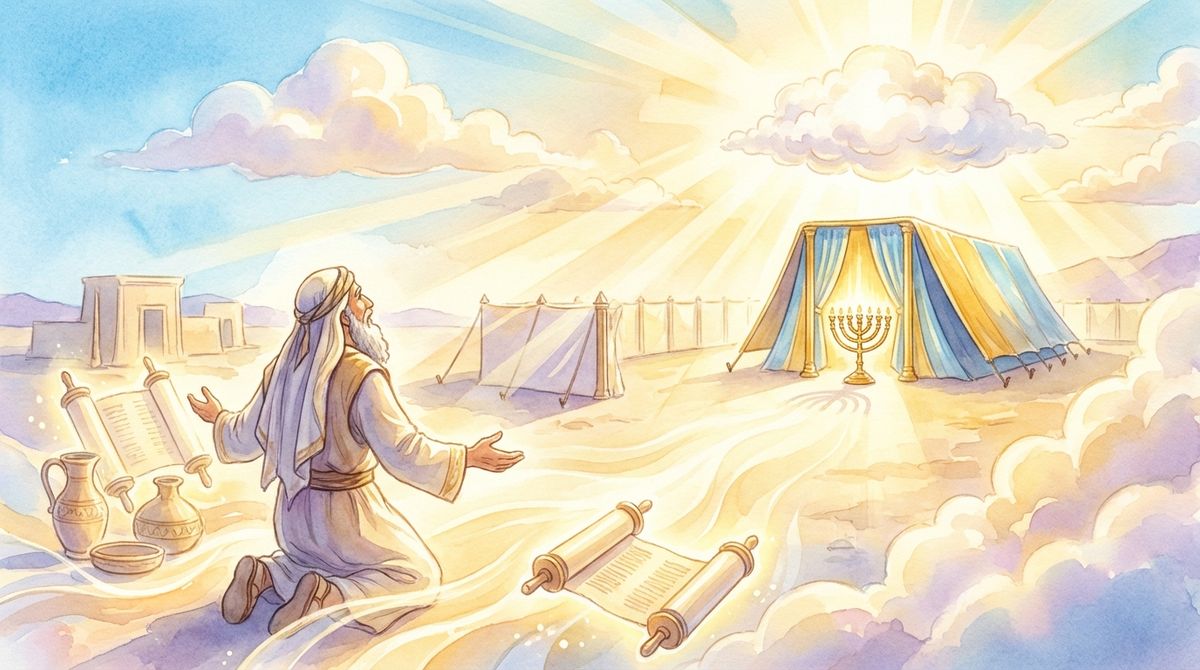
The foundation of the concept of the true tzaddik is explained in the book Matok MiDvash (Part 2, 238b). He explains that all the tzaddikim, including Betzalel, made the parts of the Mishkan. They rectified every detail and component, were meticulously precise, and performed mystical intentions (kavanos) and unifications (yichudim) on every nail and socket. They did Hisbodedus, prayed, went on the mountains, and cried out to Hashem. But when they wanted to connect all the parts together—no one succeeded. No part would connect to the other.
They said to Moshe, "What is happening here?" Moshe answered them, "You could try for a million years and you wouldn't succeed in connecting anything."
The question is asked: Who is Moshe? How did he become Moshe? Did he pray more? The Matok MiDvash explains: There is a supernal power that does not depend on the prayers of the tzaddikim. Moshe reached such a state of "Ayin" (nothingness), such absolute nullification, that no action in the world can be done without his power.
Korach's Mistake and Emunah (Faith) in the Tzaddik
Moshe Rabbeinu is the aspect of "Ba'ala D'Matronisa" (the husband of the Shechinah - Divine Presence), while Aharon is merely the shoshvin (groomsman). On the day Moshe completed the Mishkan, the Shechinah became Moshe's bride. The moment they presented the parts of the Mishkan to Moshe, everything immediately connected on its own. This is a power that does not depend solely on Torah and prayer, but rather something completely beyond human comprehension. Of course, one reaches this through Torah and prayer to the point of mesiras nefesh (self-sacrifice), but ultimately, a new wellspring opens up—a new Sefirah (Divine emanation) that no person in the world can grasp. All the parts fell into place by themselves, simply because they were brought to Moshe. The moment you believe in Moshe—everything connects on its own.
This was the root of Korach's mistake and his punishment. Korach disputed Moshe because he refused to believe that such a thing exists in the world. He argued that Moshe had ordinary powers—perhaps he was a bit stronger in prayer, in learning, or in righteousness, but he could not stand against the entire congregation.
Rebbe Nachman says that Korach was actually correct in his calculation, because no ordinary tzaddik can stand against the six hundred thousand of the Jewish people—millions of holy and pure Jews who heard at Mount Sinai:
"I am Hashem your God" and "You shall have no other gods."
However, Korach did not know that Moshe was equal to everyone and greater than everyone. Moshe's power was a power beyond all comprehension. Even Korach, who was wise, clever, and a prophet, who saw with Ruach HaKodesh (Divine Inspiration) all the way to Shmuel the Prophet and to the end of generations, could not grasp who Moshe Rabbeinu was. If only we would merit to truly believe that there is such a thing called Moshe Rabbeinu, through whom everything connects and happens on its own.
Part 2 of 5 — Lesson No. 22
All Parts: Part 1 | Part 2 (Current) | Part 3 | Part 4 | Part 5
Subscribe to Our Newsletter
Receive Torah articles and inspiration directly in your inbox