The Deep Secret of the Luchos: Why Wasn't "Tov" Written on the First Tablets?
Lesson No. 32 | Lesson 1 - (Continuation from No. 31) Friday Morning, Parashas Matos, 23 Tammuz 5755
This article explains the deep connection between the breaking of the Luchos (Tablets) and the histalkus (passing away) of Elimelech and Machlon in Megillas Ruth (the Book of Ruth). Through a Talmudic discussion in Tractate Bava Kamma, it is explained that the first Luchos were hewn from an exalted place where evil has no hold whatsoever, which is why the word "tov" (good) was not written on them, and how the tikkun (rectification) of the Sin of the Golden Calf is accomplished in every generation.
The histalkus (passing away) of Elimelech and Machlon in Megillas Ruth is not merely a historical event; rather, it is an actual manifestation of the breaking of the Luchos. When Elimelech and Machlon passed away, the breaking of the first Luchos occurred in the world, and those who remained—Ruth and Naomi—represent the aspect of the second Luchos.
The Secret of the Luchos in Megillas Ruth
To understand this deeply, we must contemplate a question brought in Tractate Bava Kamma (55a). The Gemara asks there:
"Why is 'tov' (good) not stated in the first Ten Commandments, yet 'tov' is stated in the latter Ten Commandments?"
Seemingly, what kind of question is this? Every child knows what is written on the Luchos! Rather, the question of the Amoraim was much deeper: From what spiritual level did the Luchos descend? The question was not textual, but essential: Did the first Luchos come from a place so high that the word "tov" was too small for them?
Because the moment the word "tov" is spoken, it indicates that there is also evil in the world. If there is pure—it is a sign that there is impure. If you say there is good, you necessarily acknowledge the reality of evil.
Above Good and Evil
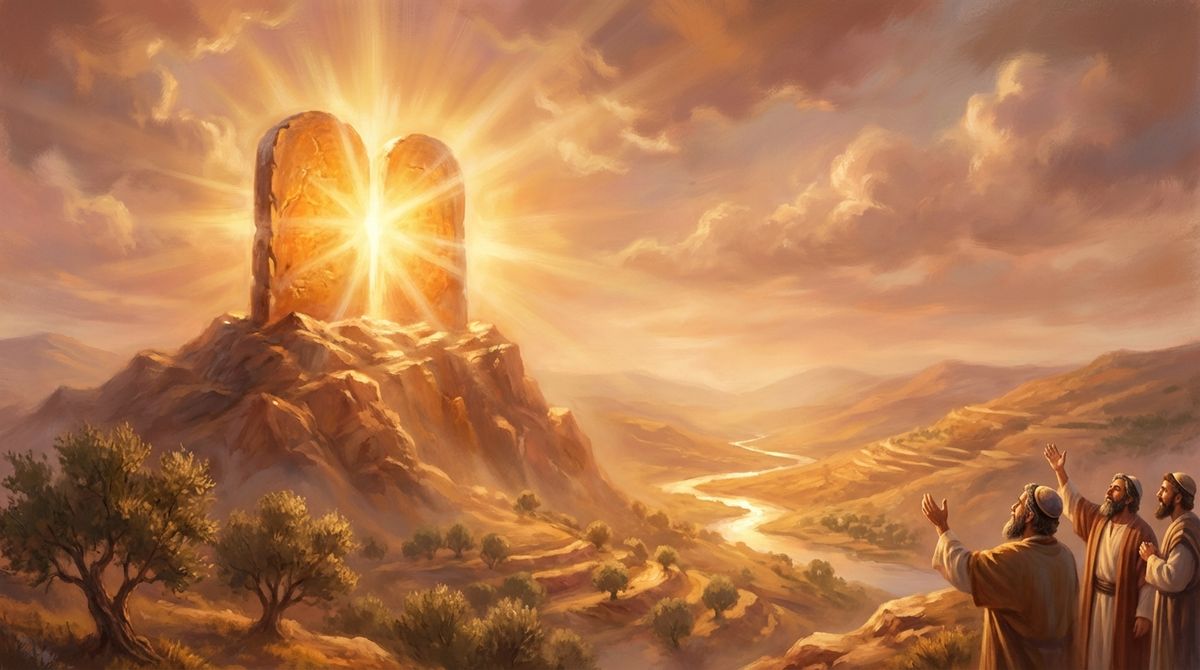
The first Luchos came from immense upper Sefiros (Divine emanations), from an aspect called "Atika Kadisha" (the Holy Ancient One) and "Arich Anpin" (the Long Face, representing infinite Divine mercy). In this lofty place of "Atika Kadisha," the concept of good does not apply at all, because there is absolutely no evil there. The first Luchos were above good, on the level where "their impurity ceased" (the absolute purification from the primordial sin), a place where it is completely impossible to even say the word good.
In contrast, after the breaking of the Luchos, we descended to the level of the second Luchos. There, the concept of "tov" already applies, and therefore it says in them, "so that it may be good for you." This is the secret of the verse, "He who finds a wife finds good" (Proverbs 18:22)—the aspect of the woman, which is the aspect of Naomi and Ruth, represents the second Luchos in which "tov" shines. The first Luchos, however, included the complete illumination of Elimelech and Naomi, Machlon and Ruth together.
Rectifying the Sin of the Golden Calf in Every Generation
After the first Luchos were broken, to our sorrow, they are broken anew in every single generation. This is our great sorrow—on the seventeenth of Tammuz the Luchos descended, and we did not merit to receive them. The breaking of the Luchos during the time of the Judges was expressed through the histalkus (passing away) of Elimelech and Machlon.
In every generation, there is an aspect of making a Golden Calf, and our entire purpose is to rectify this calf. Avraham Avinu (our Patriarch Abraham) rectified the two calves of the twenty generations that preceded him—from Adam to Noach, and from Noach to Avraham. Therefore, he called the place of the Beis HaMikdash (the Holy Temple) a "Har" (Mountain), and together with the aspect of "Ru" (the numerical value of 206, which equals two times the value of "egel" or calf), these represent the rectification of two calves. After him came Yitzchak Avinu and rectified the calf of his generation, and then the place was called "Sadeh" (Field, which has the gematria of 309). Afterward came Yaakov Avinu, rectified the calf of his generation, and called the place "Bayis" (House).
If we did not receive the Luchos on the seventeenth of Tammuz and they were broken, it is a sign that we made a Golden Calf. And what is the making of the Golden Calf in our generation? It is the histalkus (passing away) of the tzaddikim. The moment awesome tzaddikim pass away, it is literally the breaking of the Luchos.
Thunder and Lightning in Beis Lechem (Bethlehem)
When the righteous men and women pass away, all the Luchos are broken. However, since in Megillas Ruth only Elimelech and Machlon passed away, Naomi and Ruth remained. Regarding this it is said:
"And the two of them went until they came to Beis Lechem" (Ruth 1:19).
"And the two of them went"—these are the two Luchos, the second Luchos that remained. And when they arrived in Beis Lechem, the verse describes: "And the entire city was in a tumult [vatehom] over them." What is the meaning of "vatehom"? This is exactly what happened at the revelation at Mount Sinai, about which it is said, "And all the people saw the thunder [kolos] and the flames." Suddenly there was thunder and lightning in the city, and people heard the immense illumination of the Giving of the Torah.
May Hashem, blessed be He, help us merit to hear thunder and lightning anew, and may the Beis HaMikdash be built, and may the complete Geulah (Redemption) come, speedily in our days, Amen.
Part 3 of 3 — Lesson No. 32
Subscribe to Our Newsletter
Receive Torah articles and inspiration directly in your inbox