
The Secret of Midnight and the Dance with the Shechinah
Lesson No. 24 | Lesson 1: Monday Morning, Parashas Pinchas, 12 Tammuz 5755 at the Yeshiva
A deep sermon on the secret of rising for Chatzos (midnight prayer), the historical mistake of King Solomon that led to the spiritual decline of the generations, and the stirring teaching of the Rebbe.
The Midrash tells of a father who died and is lying in the sun, and the dogs are howling. The Megaleh Amukos asks: What is the connection between a father who died and is lying in the sun, and the dogs? He explains that this is the same question related to the "watch of the dogs" at midnight. King David would subdue them. As long as King David, who represents the aspect of the "father," was alive, he would rise, play his harp, and sing songs from midnight until the morning, thereby subduing the dogs. Now that the father has passed away, the question was asked: Who will take his place? Who will keep the watches of Chatzos and Hisbodedus (secluded prayer)?
King Solomon's Mistake and the Decline of the Generations
King Solomon did not have the strength to always rise at Chatzos. The Midrash says that this was his mistake. If Solomon had risen at Chatzos every night like his father David, he would have become Mashiach ben David, and the Holy Temple would have remained standing forever and ever. The holy Zohar explains that Solomon did not appreciate the virtue of Chatzos like his father did. He thought to himself: "My father has this spiritual level, but I built the Holy Temple. Building a Holy Temple is like a dwarf standing on the shoulders of a giant; everything was prepared for me spiritually and physically, and I only needed to strike the final blow."
The Zohar in Parashas Vayechi explains that the moment Solomon failed to grasp the secret of Chatzos—that without Chatzos there is nothing—the downward descent began. From Avraham Avinu (our Patriarch Abraham) until King Solomon, there were fifteen generations of ascent, like the waxing moon. But because Solomon did not rise at Chatzos, a process of "diminishing and lacking" began, consisting of fifteen generations of decline from Solomon until King Tzidkiyahu.
The Teaching of the Klausenburger Rebbe in the Valley of the Shadow of Death
When midnight arrives, and one rises to serve the Creator, Hashem goes out to stroll with the tzaddikim in the Garden of Eden. This is brought down in the Zohar and the Tikkunei Zohar. In this context, we will mention the Klausenburger Rebbe zt"l, who survived the inferno of the Holocaust. He endured horrific suffering, death marches of hundreds of kilometers, and murderous beatings, as time and again, another Jew and another Jew was killed right before his eyes.
On Shabbos Chazon of the year 5704 (1944), while they were on the way to the camps, severely wounded from the many beatings they had received, he delivered a tremendous sermon and connected it to the words of the holy Zohar:
"It was taught: There is no Shabbos where Hashem does not go to dance with the tzaddikim in the Garden of Eden."
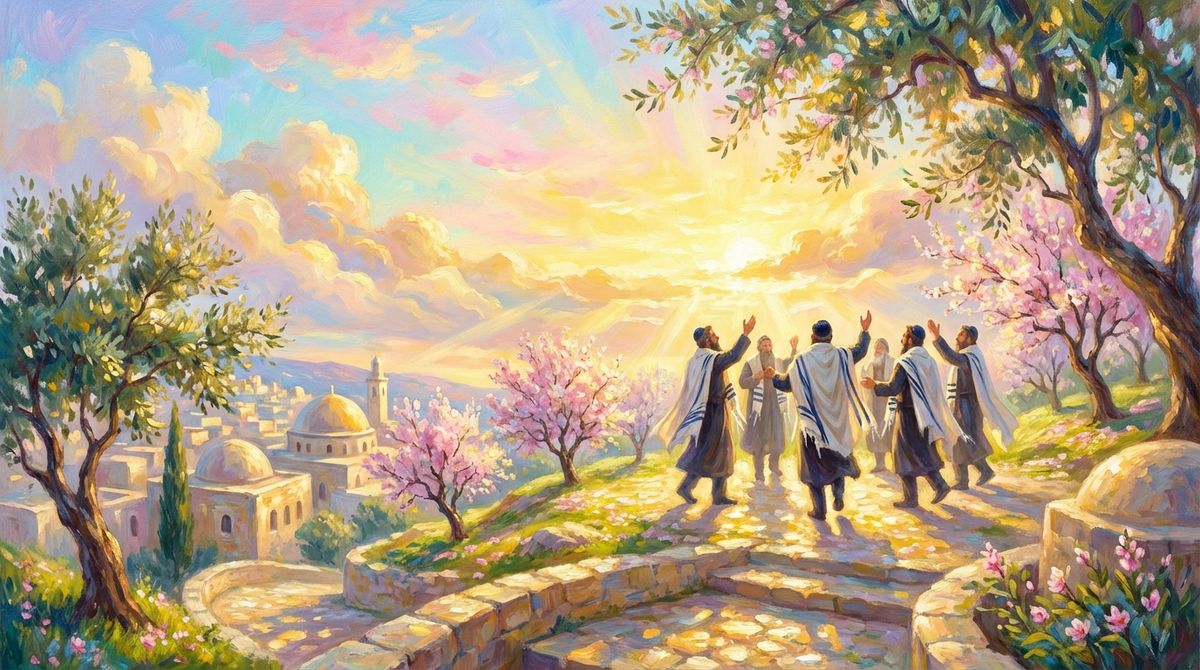
Every single Shabbos, Hashem, as it were, in all His glory, goes to dance and rejoice with the tzaddikim in the Garden of Eden, and they are all nourished by the radiance of the luminous mirror (Divine revelation). The Klausenburger Rebbe said to that group of broken and crushed Jews: Shabbos Chazon is the greatest Shabbos of the year! Throughout the entire year, the Shechinah (Divine Presence) is in exile, and there is the sorrow of the Shechinah. But when Shabbos arrives, the Shechinah goes out in dances and circles. She strips off her garments of widowhood and goes out to dance for the entire Shabbos.
Ignoring the Personal Exile and Going Out to Dance
We are indeed in exile, but this is the stage where we are required to overcome our exile. We must overcome all of our constricted consciousness (mochin d'katnus) and go out in dances and circles together with the Shechinah. The Shechinah is constantly singing, dancing, and rejoicing. And we need to nullify our severities and judgments, all of our exhaustion and personal excuses—"I have a mortgage," "I have no money"—each person with the pettiness of their own personal exile.
Everyone must ignore their own personal exile, enter into the holy Shechinah, and go out in dances and circles together with her. In the merit of these dances and circles, we will fulfill the word of Hashem and merit the complete Geulah (Redemption) speedily in our days, Amen.
Part 3 of 4 — Lesson No. 24
Subscribe to Our Newsletter
Receive Torah articles and inspiration directly in your inbox