The Secret of the Easy Mitzvah: The Test of the Nations of the World in the Future to Come
Shiur No. 60 | Thursday Night, Parashas Chukas, Eve of 4 Tammuz 5756 - A Shiur for the General Public at the Yeshiva
This article explains the secret of the word "Kahal" (congregation) and its connection to the mochin (intellect) of Rachel and the mitzvah of eating matzah. Through the Talmudic discussion regarding the test of the nations of the world in the future to come, it explains why the Sukkah is considered an "easy mitzvah" with many exemptions, and what the true test is for those who sit in it, in contrast to the root of the souls of the "Erev Rav" (mixed multitude).
The daas (knowledge) of our matriarch Rachel is referred to by the mystical secret of "Kahal". The word "Kahal" is composed of the letters "kalah" (easy), because they wanted easy things. When Korach argued against Moshe and Aharon:
"Why do you exalt yourselves over the congregation (kahal) of Hashem?" (Numbers 16:3)
He actually meant to say that these people have a "light" or easy intellect, and they do not possess your high level of daas. The word "Kahal" (Kuf, Hei, Lamed) contains the exact same letters as "kalah" (easy), and its gematria (numerical value) is 135. This is exactly the numerical value of the word "matzah" (Mem, Tzadi, Hei). By eating matzah, we merit to receive these *mochin*, which are called the "*mochin* of Rachel" or the "*mochin* of Imma" (the Supernal Mother), which are characterized as "kalah" (easy).
The Claim of the Nations of the World in the Future to Come
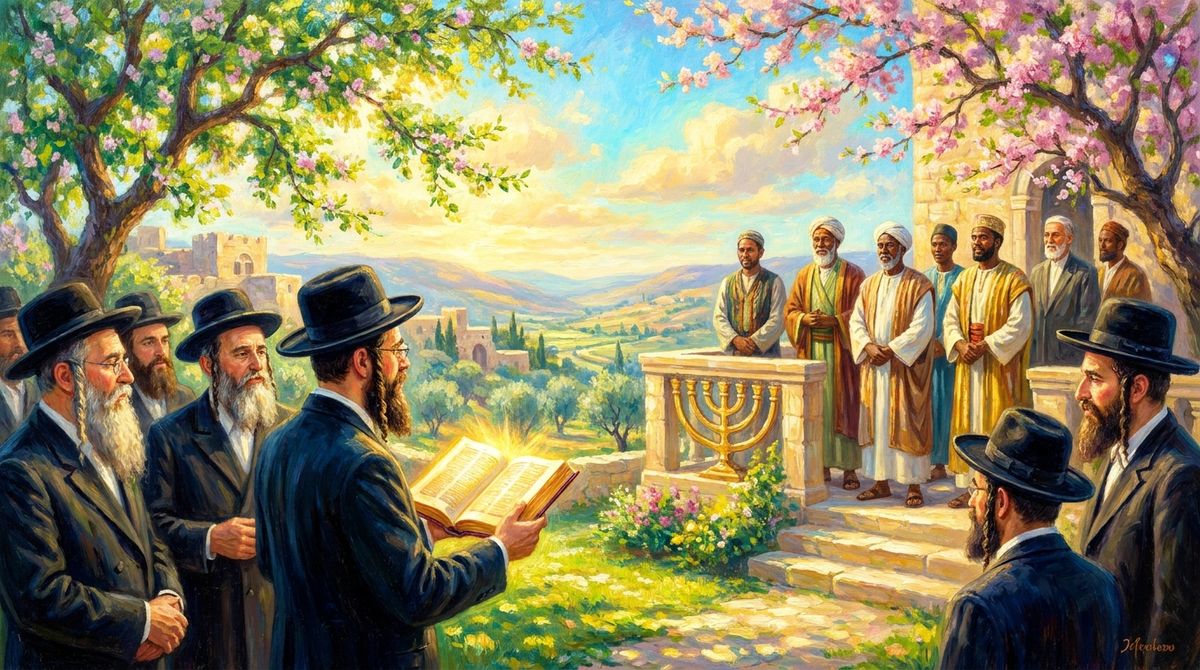
This connects to what is explained in Tractate Avodah Zarah, that in the future to come, all the nations of the world will come before Hashem and demand a reward. They will say, "We loved the Jews, we cared for them, we helped them, we sent them support, and we saved them from Auschwitz and other troubles."
The Gemara describes how they will demand to receive a reward like the Jewish people, saying, "We want the Torah, we want mitzvos, we want to be like the Jews." In response to their demands, Hashem will tell them, "I will give you one mitzvah. If you withstand the test of this mitzvah, you will be able to receive more mitzvos. But if you fail it, I will not be able to give you any additional mitzvos."
Why is the Sukkah Considered the "Easiest" Mitzvah?
The mitzvah that Hashem gives them is the mitzvah of Sukkah, and the Gemara calls it an "easy mitzvah." The question arises: Why specifically is the Sukkah considered an easy mitzvah? After all, tzitzis is seemingly an easy mitzvah too—you take a garment, attach four fringes to it, and it takes even less time than building a Sukkah!
The difference is that with tzitzis, a person might find various excuses. In the summer, he will say it is too hot and he is sweating, and when winter arrives, he will claim, "I've gotten used to walking around without tzitzis for half a year, so I'll just continue like this." These are not valid excuses according to Halacha (Jewish law), and it shows a lack of seriousness. In contrast, with the mitzvah of Sukkah, there are endless exemptions anchored in the Halacha itself. A person can say, "I'm hot," "I'm cold," "There are mosquitoes," "It's noisy outside," or "Leaves are falling on me." According to Halacha, "one who is uncomfortable is exempt from the Sukkah," and therefore, a person can find a million excuses in a second, and all of them will be halachically valid. Because of this, the Sukkah is called an "easy mitzvah"—because it has the most exemptions.
The Root of the Soul in the Clouds of Glory
Unfortunately, many people use these exemptions and do not sit in the Sukkah. The holy Zohar in Parashas Emor says piercing words about this: Whoever does not sit in the Sukkah, even if he appears to be the greatest tzaddik, it is a sign that he stems from the root of the "Erev Rav" (mixed multitude).
Why? Because this testifies that his soul did not sit in the sukkos in the desert under the Clouds of Glory, and therefore he has no feeling or connection to this mitzvah. Due to this lack of inner connection, he finds a new halachic excuse every moment—one time it's a heatwave, another time it's mosquitoes, and another time it's noise.
The Blazing Test of the Nations in the Sukkah
Because of this multitude of exemptions, Hashem chooses to give the nations of the world specifically the mitzvah of Sukkah. He is, as it were, saying, "I don't want to make it hard for them. I will give them the mitzvah where if it is just a little unpleasant, or if a fly enters the Sukkah—they can already be exempt from it according to the law."
But the nations of the world want to prove their righteousness. They want to show that they too have mesiras nefesh (self-sacrifice) for fulfilling mitzvos. Hashem tests them and takes the sun out of its sheath, specifically during the blazing period of Tammuz. There is a heavy heatwave of fifty degrees Celsius. Despite this, the nations decide that they will fulfill the mitzvah with *mesiras nefesh*. Even if they burn from the heat and people die in the streets, they don't care—they decide not to leave the Sukkah.
Part 3 of 3 — Shiur No. 60
Subscribe to Our Newsletter
Receive Torah articles and inspiration directly in your inbox