The Secret of the Torah of Melody: The Spiritual Struggle Over the Level of Receiving the Torah
Lesson No. 28 | * Friday, Parashas Pinchas, 16 Tammuz 5755 (Continued from No. 27)
A fascinating article explaining the unfolding of the Sin of the Golden Calf, starting from the jealousy of Balaam, through the struggle of the Patriarchs and the tzaddikim against it.
The Midrash in Parashas Va'eira describes the confrontation between Moshe and Aharon and the sorcerers of Egypt. When Aharon casts down his staff and it turns into a serpent, the sorcerers, Yochani and Mamre (Jannes and Jambres), mock Moshe and say to him, "Are you bringing straw to Afarayim?"—meaning, are you bringing sorcery to Egypt, the sorcery capital of the world? Moshe answers them, "To the vegetable market, one brings vegetables to sell." Specifically here, in the place that boasts of sorcery, I will prove the immense power of Hashem, until everyone will be forced to admit, "It is the finger of God."
Pharaoh does not give up, and he even brings four- and five-year-old children from the schools, and even calls his wife, so that they can perform the exact same sorcery. But then, Aharon's staff swallows all of their staffs, without becoming any thicker at all.
Balaam's Jealousy and the Plot for the Sin of the Golden Calf
Following these miracles, Balaam and his sons (Yonos and Yambros) decide to take revenge on Moshe Rabbeinu. The Midrash HaGadol explains that Balaam had planned to be the leader and redeemer of the Jewish people. He knew that the Torah is truth, and he was even willing to convert in order to take Israel out of Egypt and ascend to heaven to bring the Torah down for them. Regarding this, it is stated:
"The wicked one will see and be angry; he will gnash his teeth and melt away; the desire of the wicked will perish" (Psalms 112:10).
"The wicked one will see and be angry"—this refers to Balak; "he will gnash his teeth and melt away"—this refers to Balaam. When Balaam saw that Moshe Rabbeinu was the one ascending to heaven and bringing down the Torah, his desire perished and he decided to take revenge. His sons, Yonos and Yambros, who knew of their father's ambitions to be the one to bring down the Torah, initiated the Sin of the Golden Calf in order to cause the Jewish people to stumble and to take revenge on Moshe.
The Tzaddikim and the Struggle Against the "Calf" of Every Generation
The Sin of the Golden Calf is not a one-time historical event. Rabbi Menachem of Shklov, in his book Mayim Adirim, reveals a novel concept: in every single generation there is a new "calf"—new heresies, confusions, and temptations tailored specifically to that generation. The role of the tzaddikim in every generation is to subdue the specific calf of their time.
The holy Patriarchs began this work: Avraham Avinu subdued a double calf (corresponding to the twenty generations from Adam HaRishon until him). In Gematria (numerical value), the word 'Egel' (calf) equals 103. Twice 'Egel' equals 206, which is the Gematria of 'Har' (mountain). Therefore, Avraham called the site of the Holy Temple a "mountain." Yitzchak Avinu subdued the calf of his generation, adding another 103, which creates the number 309—the Gematria of 'Sadeh' (field). Yaakov Avinu subdued yet another calf, reaching 412, the Gematria of 'Bayis' (house).
This is the reason King David says in Psalms:
"May Hashem answer you in the day of distress; may the Name of the God of Yaakov fortify you" (Psalms 20:2).
The Gemara in Tractate Berachos asks why specifically Yaakov is mentioned, and not Avraham and Yitzchak? The answer is that we always follow the latest tzaddikim. The final tzaddik is the one who steps into the thick of the fray, completes the work of his predecessors, and exercises *mesiras nefesh* (self-sacrifice) to descend to the lowest generations in order to heal them and subdue their calf.
Moshe Rabbeinu and the Torah of Melody
The struggle surrounding the Golden Calf directly influenced the manner in which the Torah was given. The Gemara in Tractate Shabbos describes that when Moshe Rabbeinu ascended to the supernal realms, he found Hashem sitting and tying crowns to the letters of the Torah. Moshe was surprised by this. Why?
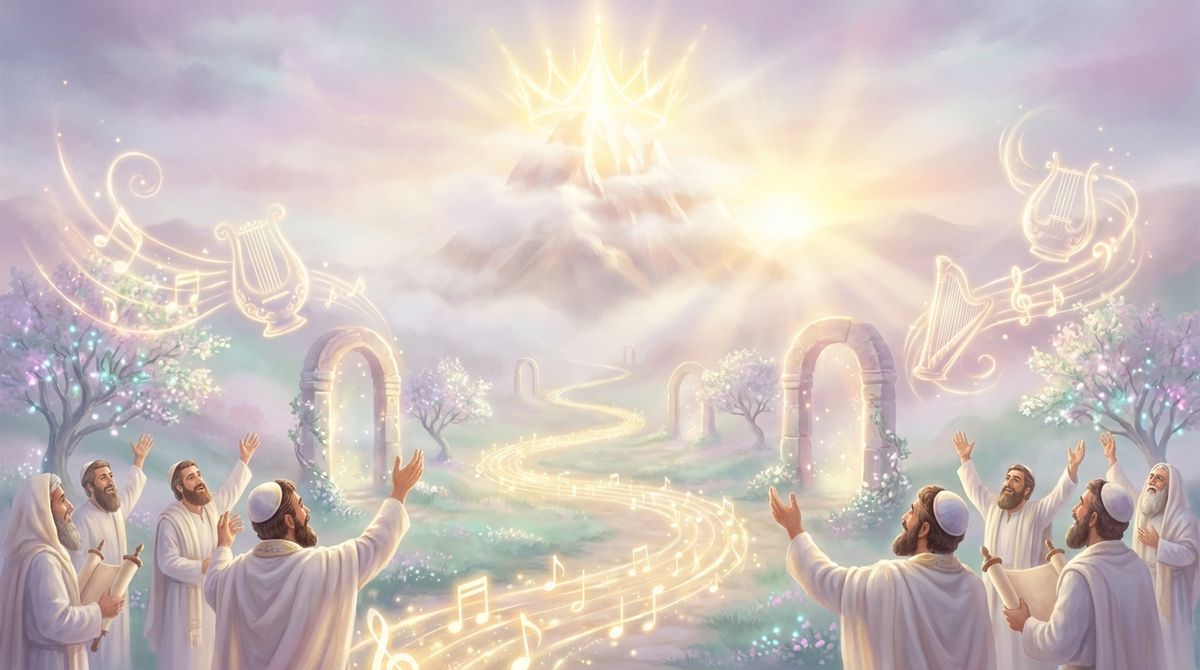
At the Splitting of the Red Sea, it is stated: "Then Moshe sang." Moshe Rabbeinu had already elevated himself to the world of "Ta'amim" (cantillation notes)—the world of melody and song. All the songs of the Future to Come, the songs of the Resurrection of the Dead, and the melodies of the Garden of Eden were revealed to him. Moshe wanted to bring down to the Jewish people a Torah of melody—a Torah entirely composed of *deveikus* (cleaving to God), song, and the Resurrection of the Dead, which would draw the Garden of Eden down into this world.
However, when Moshe ascended Mount Sinai, the Jewish people had already begun to descend spiritually and entertain thoughts of making the Golden Calf. Because of this descent, the Torah could not be brought down in its highest form as "Ta'amim" and melody alone. Therefore, Moshe saw Hashem tying crowns to the letters—the Torah was forced to clothe itself in the garments of letters, crowns (tagin), and practical Halachos (Jewish laws), in order to adapt to the new spiritual state of Israel.
The Rapid Descent of the Generation of the Wilderness
The spiritual descent of the Jewish people was rapid. The Midrash asks: How long did Israel hold out before they began planning the Sin of the Golden Calf? After all, a calf is not made in a single day; it requires planning and thought.
The Tanna'im (Mishnaic sages) disagreed on this matter: Rabbi Shimon bar Yochai says that the Jewish people held strong for only 11 days, and during the remaining 29 days, they were already calculating how to make the Golden Calf. Rabbi Elazar ben Yaakov holds the opposite view—they held strong for 29 days, and only during the last 11 days did they plan the sin. Rabbi Yehuda takes a stricter view, stating that they held strong for only a single day, while Rabbi Shimon ben Chalafta says they held strong for two days.
The moment the Jewish people began to doubt whether Moshe would return, they sought alternative leadership. This spiritual descent, as the holy Arizal explains, continued throughout the entire forty days. Because of this descent, the Torah of the world of *te'amim* (cantillation marks) and melody was hidden away, and Moshe had to settle for bringing down a Torah of letters and crowns—a Torah suited for the reality of a world where there is still a need to battle the "Golden Calf" of every generation.
Part 2 of 4 — Lesson No. 28
Subscribe to Our Newsletter
Receive Torah articles and inspiration directly in your inbox