
The Secret of the Unification of the Bride and Groom and the Sweetening of Judgments Through Dancing
Lesson No. 204 | Lesson 1 - Wednesday, Parashas Eikev, the Eve of the 16th of Menachem Av 5759 - Sheva Brachos (Seven Blessings) at Chinuch Yerushalayim
An in-depth discourse on the holiness of the wedding ceremony, explaining how the mitzvah dances sweeten judgments for years to come. Through the secrets of Kabbalah and the Book of Esther, it explains how the bride is the aspect of the Shechinah (Divine Presence), and how a husband's care for his wife draws down abundance upon all of Israel.
"Hashem, open my lips, that my mouth may declare Your praise."
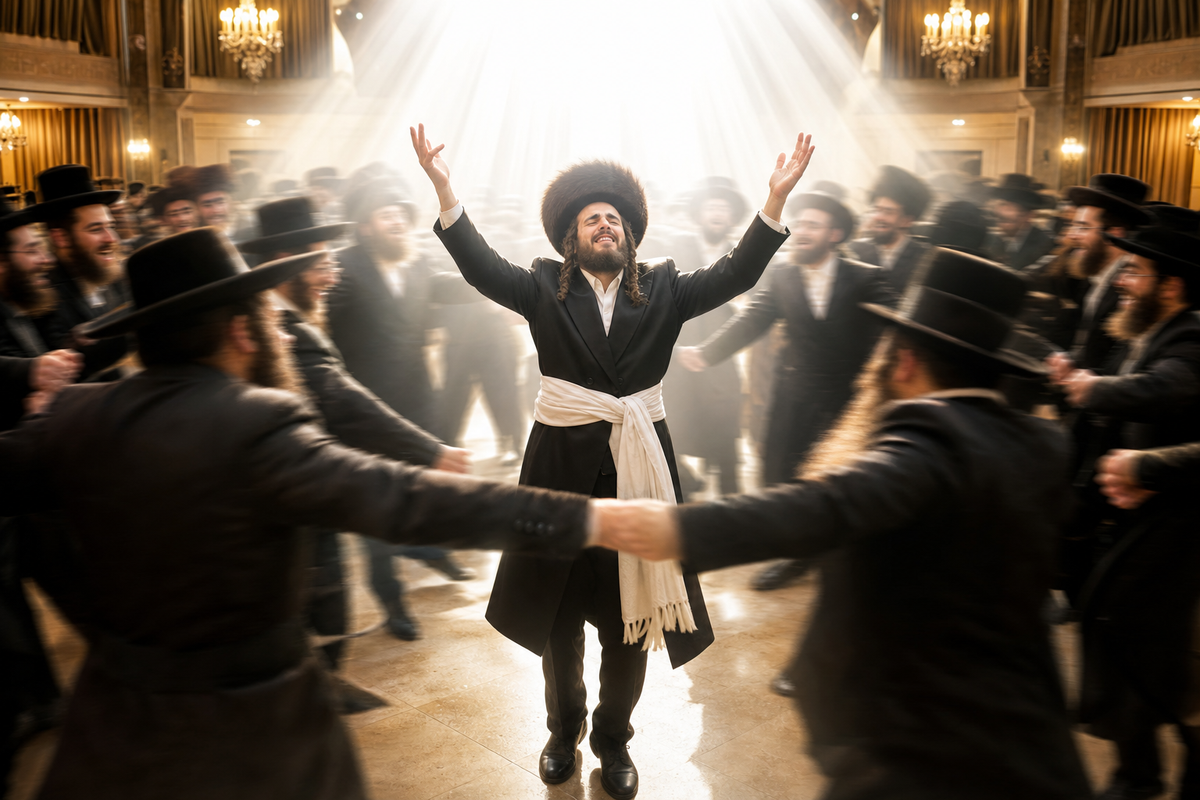
Dancing is the aspect of the Shemoneh Esrei (the silent standing prayer). Through dancing, one merits to ascend to the Sefirah of Kesser (the highest Divine emanation of Crown), ascending to the level of "Ta'amim" (the highest spiritual level of Torah cantillation notes). Wedding dances are the highest thing that can possibly be, truly the aspect of Ta'amim.
The Secret of Chasadim (Kindnesses) and Gevuros (Judgments)
In the Torah, the word "na'arah" (young woman) is usually written without the final letter Hei, spelling "na'ar" (young man), which hints at the 320 severe judgments. Only in a few instances, such as "the father of the na'arah," is it written with the letter Hei. The letter Hei symbolizes the five Chasadim (Divine kindnesses), just as Avraham Avinu (our Patriarch) received the letter Hei added to his name.
The young woman receives the letter Hei through the groom. The bride is the aspect of the five Gevuros (judgments), and the groom gives her the five Chasadim (kindnesses). This is the complete unification of kindnesses and judgments, and this is the tremendous secret of the bride and groom – the unification of the Holy One, Blessed be He, and His Shechinah (Divine Presence).
As brought down in the "Pri Eitz Chaim" (Shaar HaAvodah), this is the unification of the Fifteenth of Av, the connection of the letter Yud with the letter Hei, where the groom is called Yud and the bride is called Hei.
Higher Than the Holiness of Yom Kippur
The dances at a wedding are truly the aspect of the Shemoneh Esrei prayer, through which judgments are sweetened. Through the dancing and singing at a wedding, judgments are sweetened for ten years into the future! Rebbe Nachman says that there can be illnesses decreed to come upon a person in their older years, and through the joy of the heart during dancing, everything is sweetened.
This joy is the aspect of "And Yaakov lifted his feet." Yaakov Avinu waited and prepared himself for fourteen years for his wedding with Rachel and Leah, because he knew the immense holiness of the occasion.
A wedding is the greatest thing in the world, even greater than Yom Kippur. At a wedding, all the judgments in the world are sweetened, not only for the bride and groom, but even for those who come to rejoice with them. All sins are forgiven, because the holiness of a wedding is higher than Yom Kippur.
The Bride is the Secret of the Shechinah
"There were no better days for Israel than the Fifteenth of Av and Yom Kippur."
On these days, all sins are forgiven. In the past, on Yom Kippur, while the Jewish people were praying, the daughters of Israel would go out to dance in the vineyards out of immense joy over the forgiveness of sins. They would go out in borrowed white garments, to show that everything had become white and pure.
For this reason, the bride is dressed entirely in white, because the bride is the secret of the holy Shechinah (Divine Presence).
The "Kedushas Levi" in his discourse on Purim explains that Mordechai knew that only Esther could subdue Haman and Achashverosh. The holy Zohar (Parashas Shlach Lecha) says that when Achashverosh saw Esther, he immediately fainted and his soul nearly left him, because he saw the Shechinah resting upon her.
This resting of the Shechinah depends on the groom. During the Sheva Brachos (Seven Blessings), we bless with the Name of Hashem and His Kingship: "Bring great joy to these loving friends, just as You brought joy to Your creation in the Garden of Eden of old." The goal is for their lives to truly be a life of the Garden of Eden. Everything depends on the kosher groom. The groom is the aspect of "Zeir Anpin" (the Divine configuration of the lower emotional attributes), the secret of the Holy One, Blessed be He, and he has the power to sweeten every judgment in the world.
Inquiring About the Welfare of the Shechinah
Rebbe Nachman says that from the conversations and stories of women, one can know the status of the Shechinah, where it currently stands. Regarding Mordechai, it is said: "And every single day Mordechai would walk in front of the courtyard of the house of the women, to know the welfare of Esther." Esther is the aspect of the Shechinah.
The Midrash (Esther Rabbah) says regarding this: Hashem said to Mordechai, "You inquired about the welfare of one woman? I will grant you the merit to seek the welfare of all of Israel!" When a man cares for his wife, takes responsibility for her, and protects her, Hashem grants him the merit to care for the welfare of all of Israel.
Regarding Mordechai it is said, "And he brought up [omen] Hadassah." The role of the man is to instill emunah (faith) in the woman. Through his Torah study, he instills in her the knowledge of emunah, even though the root of the woman herself is entirely the pinnacle of emunah.
Part 1 of 2 — Lesson No. 204
All parts: Part 1 (current) | Part 2
Subscribe to Our Newsletter
Receive Torah articles and inspiration directly in your inbox