The Secret of Lowliness: The Key to Eternal Life, Shabbos Delight, and the Light of Chanukah
Class No. 47 | Class 1 - Sunday, Parashas Vayishlach, 10 Kislev 5756 - Class at the Yeshiva
Rebbe Nachman teaches that a person's primary vitality and greatness lie in attaining true lowliness. Through Torah study, accepting humiliation with love, and the illumination of Chanukah, a person merits to nullify his pride, attain eternal life, and taste a semblance of the World to Come through the delight of Shabbos.
When the gates of wisdom and knowledge are opened for a person, Rebbe Nachman says in Likutey Moharan (Torah 72), he is able to truly see his own lowliness. A person's entire vitality is the feeling of "let my soul be as dust to all" — the understanding that I am the lowest, a transgressor and a sinner, and yet Hashem, may He be blessed, allows me to enter the synagogue and does not chase me away.
"But as for me, in the abundance of Your lovingkindness I will enter Your house; I will bow down toward Your holy sanctuary in awe of You" (Psalms 5:8).
The Midrash Rabbah (Parashah 32) expounds this verse in relation to Noach. Some say that Noach was considered a tzaddik only in comparison to his generation, but Noach himself interpreted this to his own detriment. He said, "How am I a tzaddik? My generation are like captured infants (who do not know any better), but I had a grandfather like Mesushelach and a great-grandfather like Chanoch, who became the angel Metatron. I am much worse than them!" Noach truly believed that if anyone deserved to drown in the Flood, it was him.
The same was true of King David. Regarding the preceding verse, "You will destroy those who speak lies; Hashem abhors a man of blood and deceit" (Psalms 5:7), the Midrash says that David compared himself to Doeg and Achitofel. David said, "I was wicked like them, perhaps even worse, for I had a father like Yishai who was completely without sin. But what is the difference between us? They fell into despair, forgot their Torah learning, and stopped coming to the study hall out of intense shame, whereas I declare, 'But as for me, in the abundance of Your lovingkindness I will enter Your house.'"
Learning Lowliness from the Tzaddikim
A person's greatest delight is when he sees that, in truth, he is wicked like all the wicked people, and perhaps even worse than them. This is the greatest vitality a person can possibly have.
They tell a story about Rabbi Mordechai of Chernobyl, who traveled to spend an entire Shabbos with a certain tzaddik. That tzaddik did not speak any words of Torah throughout the entire Shabbos. Rabbi Mordechai wondered, "Why did I even come here?" After the Grace After Meals of the second Shabbos meal, that tzaddik said to him, "One comes to tzaddikim only to learn lowliness."
The goal is to observe their conduct, their manner of speech, to see how they are insulted yet do not answer back. They are insulted but do not insult others, they hear their disgrace and do not reply, they act out of love and rejoice in suffering — they literally feel vitality when someone insults them. And we find this regarding Hashem: "Wherever you find the greatness of Hashem, there you find His humility" (Megillah 31a). Because the essence of greatness is lowliness.
The Power of Torah Against Despair
When a person studies Gemara for eight hours a day, should he become prideful? On the contrary! If he is truly learning, he arrives at lowliness. However, the Torah gives him the strength not to fall into despair and depression of the soul.
He says to himself, "True, I am the worst of all, but thank Hashem I have eight pages of Gemara in my pocket today! What tremendous vitality I have, that a wicked person like me merited to learn so much Gemara!" The moment he is filled with Torah, awe of Heaven, holiness, and prayer, he does not care if everyone else surpasses him and is better than him.
Lowliness is not sadness. Lowliness is a person's entire vitality. The primary resurrection in the Future to Come will only be for the points of lowliness that a person managed to accumulate in his lifetime. Every time a person remembers that he is worse than everyone else, he accumulates another point for the Resurrection of the Dead. "Awake and sing for joy, you who dwell in the dust" (Isaiah 26:19) — whoever makes himself like dust in his lifetime is the one who will arise in the resurrection.
A Good Eye and Raising Generations
In the span of a single hour, thousands of people pass through a person's mind, and he immediately dismisses each one: "Reuven is worthless, Shimon is a hypocrite, Levi is a loafer." If a person were to stop his thoughts, he would see that he is only nullifying others. He must think the exact opposite: "Reuven is a master of charity, Shimon sits and learns Torah, and Levi is raising ten children, thank Hashem!"
In Midrash Shocher Tov (on Psalm 45) it is stated: "Instead of your fathers shall be your sons — Rabbi Elazar bar Yosi said: In the future, each and every Jew will have as many children as those who left Egypt." If a person were to serve Hashem with simplicity and earnestness, he would merit to see six hundred thousand descendants in his own lifetime, just like our Patriarch Yaakov, who went from seventy souls to six hundred thousand within seventeen years.
The secular world tries to fight the natural population growth of the Jewish people. They bring two parrots and a fish aquarium into the world, and they see that in a few decades there will be no trace left of them, while religious families multiply ten times over. Because of this, they have a strong desire to eliminate the religious public. A story is told of a journalist from 'Maariv' who discovered many years ago that one of Shimon Peres's aides (his name was Nimrod) met in Geneva with PLO representatives and told them: "If you want to harm the Jews — only harm the religious ones." When the journalist confronted him with this information, he was shocked and tried to deny it, but after hours of interrogation, he confessed and said: "I said it, I believe in it, and that is what needs to be done." Their goal is to stop Jewish proliferation, but our role is to continue increasing life in the world, to fulfill "And may you see children born to your children, peace upon Israel."
Shabbos Delight and a Boundless Heritage
The delight of the World to Come cannot be attained right now, because we are confined within a physical body. In anything that has a limit, it is impossible to attain true spiritual delight. However, regarding Shabbos, which is a semblance of the World to Come, our Sages said: "Whoever delights in the Shabbos is given a boundless heritage" (Shabbos 118a).
How do we merit this? Only through shiflus (lowliness and humility). When a person feels that he is nothing and naught, and finds a good point in every Jew that is better than himself – he breaks out of his own boundaries. He receives an inheritance without boundaries and feels what true Shabbos delight (Oneg Shabbos) is.
A person's body wants to feel "and you shall be like God," to feel more important than everyone else. This was the sin of Adam HaRishon (the First Man). But a person must say: "Let my soul be like dust to everyone. What do I care if everyone is greater than me? Will that take away my World to Come?".
Whoever comes with humility strips himself of materialism and becomes truly "Ayin" (nothingness). As the holy Rebbe of Vizhnitz said as a play on words regarding the Mishnah: "If I am not for myself (*Im ein ani li*) – who is for me (*mi li*)." When I nullify my 'I' (*ani*) into nothingness (*ein*), I ascend to the Sefirah of Binah (Understanding), which is called 'Mi' (Who).
The Secret of the Chanukah Candle: The Oil of Wisdom
Rebbe Nachman brings in Sichos HaRan (section 261) that every person must watch with an "eina pekicha" (an open eye) to see his own lowliness and the exaltedness of Hashem, may He be blessed. A truly clever person is one who knows that everyone is better than him. Korach was clever, but he spoke foolishness and thought he was greater than Moshe Rabbeinu. Moshe Rabbeinu, on the other hand, was the most clever, and therefore he saw that everyone was better than him and was the most humble of all men.
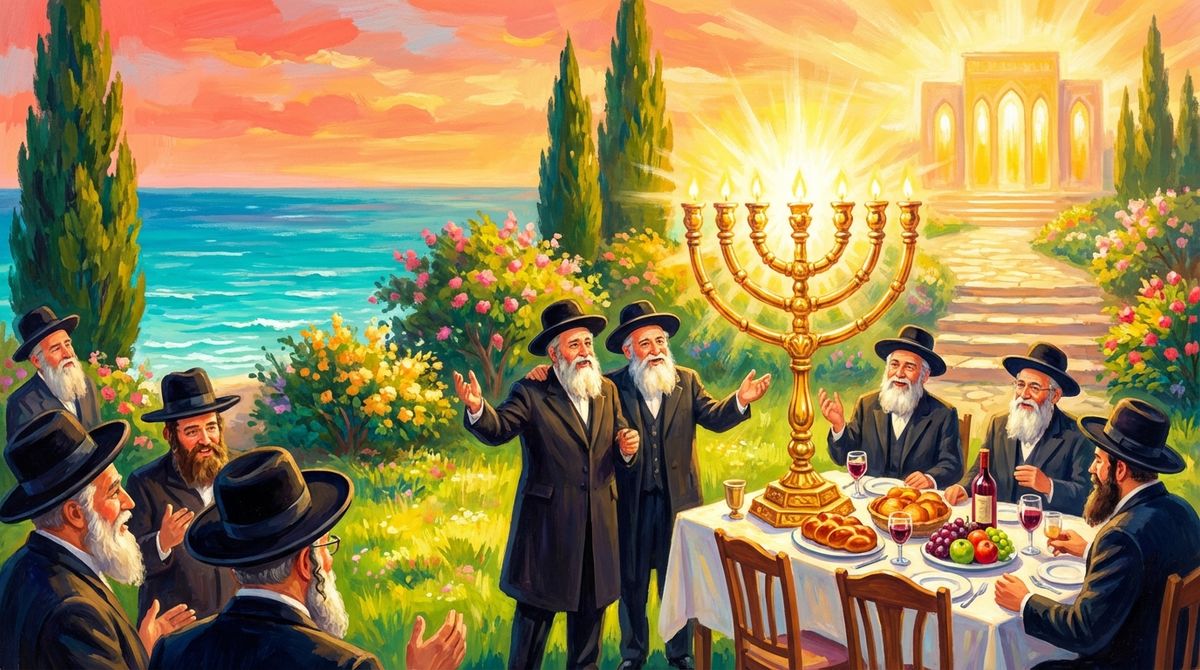
This is the secret of the Chanukah candle. The oil represents the aspect of wisdom, the aspect of eyes, as it is stated regarding Adam and Chava: "And the eyes of both of them were opened" (Bereishis 3:7), and Rashi explains: "This is said in reference to wisdom."
Before the sin, they thought they could be like God, but when wisdom illuminated them, their eyes were opened and they saw where they truly stood. Through the oil of wisdom of the Chanukah candle, the light is ignited, and a person explicitly sees his own lowliness.
Attaining this lowliness nullifies pride and lashon hara (evil speech), for lashon hara stems only from a person thinking he is better than his friend. This is the secret of "until the foot (regel) ceases from the marketplace (shuk)" (a Talmudic requirement for the timing of lighting the Chanukah menorah) – the foot represents pride. Through the oil of wisdom, we merit complete emunah (faith), true lowliness, and through this, we merit the illumination of Shabbos and eternal life.
Part 2 of 2 — Lesson No. 47
All parts: Part 1 | Part 2 (current)
Subscribe to Our Newsletter
Receive Torah articles and inspiration directly in your inbox