The Secret of the Heel: The Way to Illuminate All the Souls of Israel
Lesson No. 34 | Tuesday Morning, Parashas Masei, 27 Tammuz 5755, in the Yeshiva.
A person is required to make every effort and endeavor in serving Hashem, just as Queen Esther did. However, the main thing is to reach a recognition of true lowliness, to be in the aspect of...
When a person faces a spiritual test or danger, he must use every "tatzdeki" (tactic and effort) to push away the evil, even for a single second. Just as Aharon HaKohen had to cast the sorcery to the ground in order to nullify it, so too a person is required to act in every possible way to be saved.
The Self-Sacrifice of Queen Esther
The Vilna Gaon, in his novel insights on Megillas Esther, explains the verse:
"And when the turn of Esther, the daughter of Avichayil, the uncle of Mordechai, who had taken her as a daughter, came to go in to the king..." (Esther 2:15).
The Gaon points out that there is a multiplicity of descriptions and terms here. Why? Because Esther made every possible effort to avoid going to Achashverosh. She lay down on the ground, rolled down the stairs, claimed she was in pain, threw herself down, and bruised herself. She tried every possible tactic, hoping that perhaps at the last moment they would take pity on her and leave her alone.
Someone who has a soul does not need to be told anything—the soul already teaches him what to do. The entire purpose of a person in this world is to merit receiving a soul. In the merit of Esther's mesirus nefesh (self-sacrifice), as she did everything in her power to be saved, Hashem helped her, and she succeeded in expelling all the evil influences and demons from within herself.
To Be Despicable in One's Own Eyes
The true tzaddik is like a spiritual "vacuum" that can draw out and extract all the demons and kelipos (spiritual impurities) from a person. When a person draws close to tzaddikim who are truly humble, who are at the peak of lowliness, he merits to be purified.
Regarding this, Rabbi Yisrael of Ruzhin zy"a said in his commentary on the verse:
"The stone that the builders rejected has become the chief cornerstone" (Psalms 118:22).
What is this "stone that the builders rejected"? This refers to a state where a person is despicable in his own eyes. When a person truly understands and sees his own lowliness, to the point that he becomes repulsive in his own eyes—specifically then, before Hashem, he becomes the "chief cornerstone."
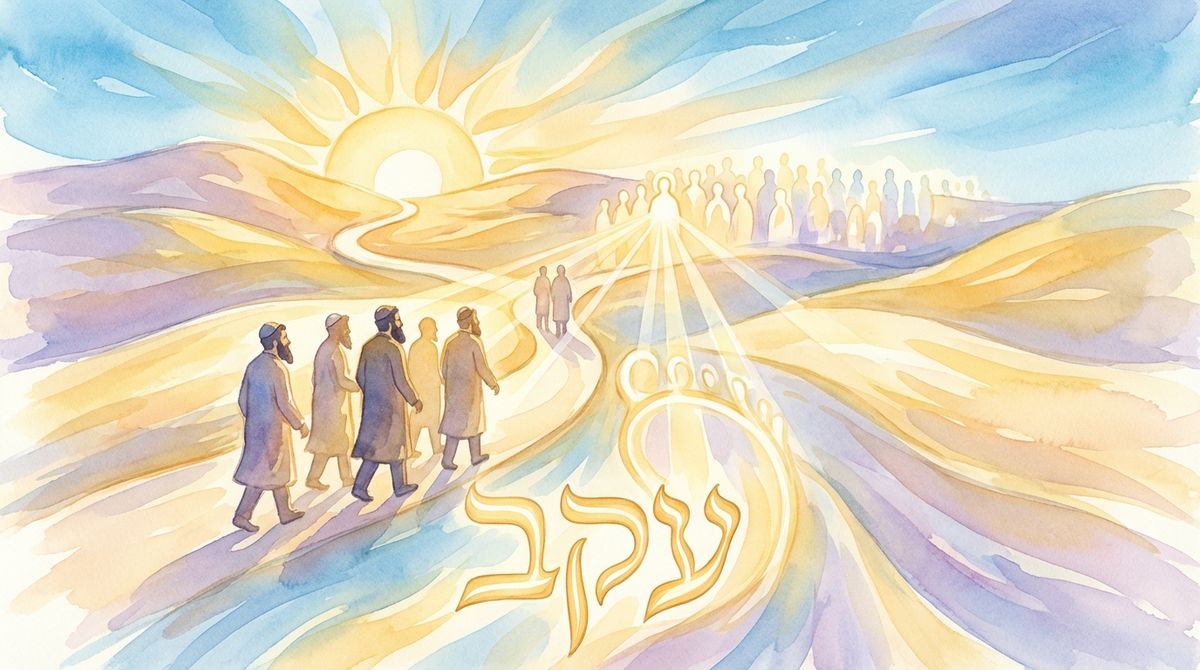
The Secret of the Heel: Illuminating the Lowest Souls
The Ruzhiner continues and explains the verse, "And it will be, because [Eikev] you will listen" (Deuteronomy 7:12). The Noam Elimelech expounds on this using the verse from Psalms: "I have inclined my heart to perform Your statutes forever, to the very end [Eikev]"—meaning, I always hold myself in the aspect of a "heel" (Eikev), the lowest limb.
The Ruzhiner asks: How will the souls in the heels hear? After all, we want to bring all of the Jewish people back in teshuvah (repentance), and indeed, this could be accomplished if only we acted properly. The answer lies in the word "Eikev" (heel). If you know that you are a heel, that you are the heel of the entire Jewish people—only then will you be able to draw down illumination to the souls that are in the heels.
In order to positively influence the souls of the generation that are in the lowest places, in the aspect of the "heels of Esav," everything depends on a person knowing that he himself is the heel, that he is the lowest in the world.
Honoring All Who Fear Hashem
The central spiritual work of a person is described in the verse:
"In his eyes, a vile person is despised, but he honors those who fear Hashem" (Psalms 15:4).
When a person is "despised and rejected in his own eyes" (Psalms 15:4), he merits to fulfill the continuation of the verse—to honor all those who fear Hashem in the world. The great test of a person is not to settle for honoring only his personal rabbi, but to truly honor all those who fear Hashem.
Rebbe Nachman of Breslov (Likutey Moharan, Torah 22) teaches that when a person honors all the tzaddikim of the generation, the true renowned leaders, he can be included with all the souls of Israel. Since it is very difficult to love each and every Jew individually, the advice is to recognize and honor the true tzaddikim, through whom one is included in the entirety of Israel.
The Conditions for Recognizing the Tzaddikim of the Generation
In Torah 282, it is explained that every tzaddik has souls that belong to him, which are considered "infants," to whom he imparts the "breath of the mouth that has no sin." Every tzaddik in the generation is considered a shepherd, as it is stated: "And pasture your kids beside the shepherds' tents" (Song of Songs 1:8). The infants receive the holiness of speech from the tzaddikim of the generation, and every tzaddik builds a Mishkan (Tabernacle) from those spiritual infants.
But how can a person merit to recognize who the true tzaddikim are? To do so, he must be clean of three severe things, which correspond to the three cardinal sins:
First, he must be clean of "idol worship"—meaning, he must have perfect emunah (faith), that he should have no fear of anything in the world except for Hashem, may He be blessed.
Second, he must be clean of "sexual immorality"—to guard his holiness and immediately do teshuvah (repentance) for any blemish or forbidden sight.
And third, he must be clean of "bloodshed." **Spiritual bloodshed means \
Part 2 of 3 — Lesson No. 34
Subscribe to Our Newsletter
Receive Torah articles and inspiration directly in your inbox